You’re missing one tooth. Just one. But now you’re sitting with two treatment plans – one for a dental bridge at $3,500, another for an implant at $4,800. Your dentist says both work. Your insurance covers more of the bridge. Your research shows implants last longer. And you’re stuck trying to figure out which option makes sense for your mouth and your wallet.
I’ve walked hundreds of patients through the dental implant vs bridge decision—helping them understand the clinical, financial, and long-term differences between these two tooth replacement options. They’re both solid solutions for replacing a single missing tooth, but they work completely differently. One approach alters your adjacent teeth. The other requires surgery but leaves neighboring teeth untouched. That fundamental difference ripples through everything – how they’re placed, what they cost, how long they last, and which situations favor each option.
Here’s what you actually need to know when comparing dental implant vs bridge options—including clinical differences, long-term costs, and which treatment makes the most sense for your specific situation. We’ll use real examples so you can see how this plays out in actual treatment decisions.
Dental Implant vs Bridge: What’s the Real Difference?

Let’s start with the mechanics because understanding how each option functions helps everything else make sense.
The Bridge Approach
A dental bridge uses your natural teeth as anchors. Your dentist prepares the teeth on either side of the gap – removing outer structure and reshaping them to accept crowns. Think of it like preparing posts to support a structure. These prepared teeth become the foundation for a connected unit that includes crowns on the anchor teeth with a replacement tooth suspended between them.
The lab creates this entire unit as one piece. At your second appointment, your dentist cements the bridge permanently in place. The replacement tooth literally “bridges” the gap, held by the crowns on adjacent teeth. You can’t remove it. It functions as a permanent restoration.
Here’s the key point – you’re permanently altering two healthy teeth to replace one missing tooth. Those anchor teeth get reshaped significantly. There’s no going back to their original structure once they’re prepared for crowns.
The Implant Approach
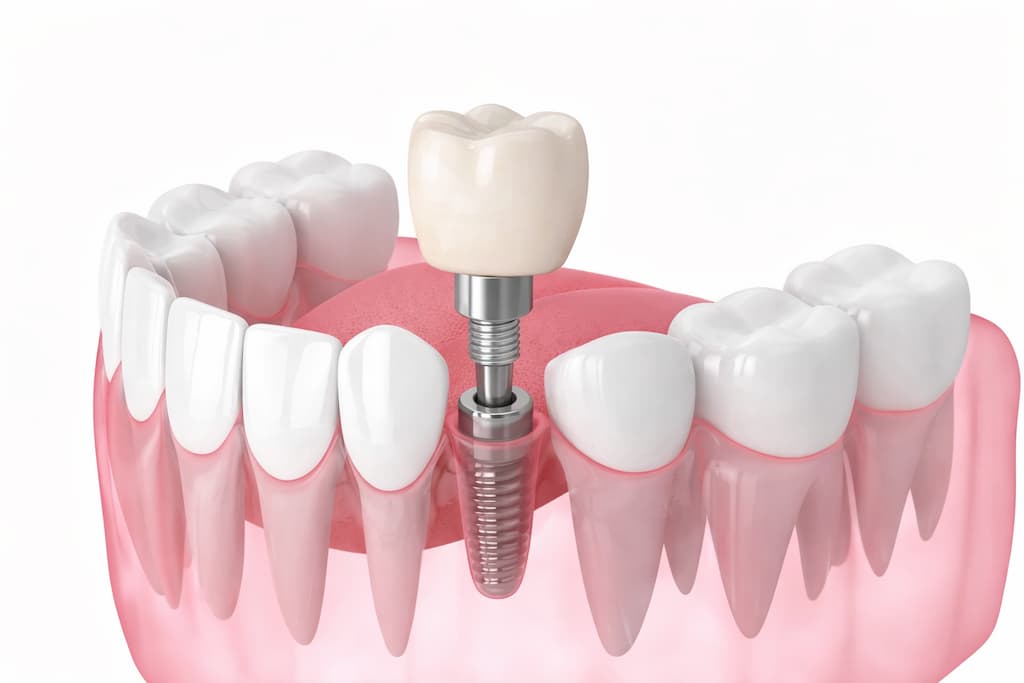
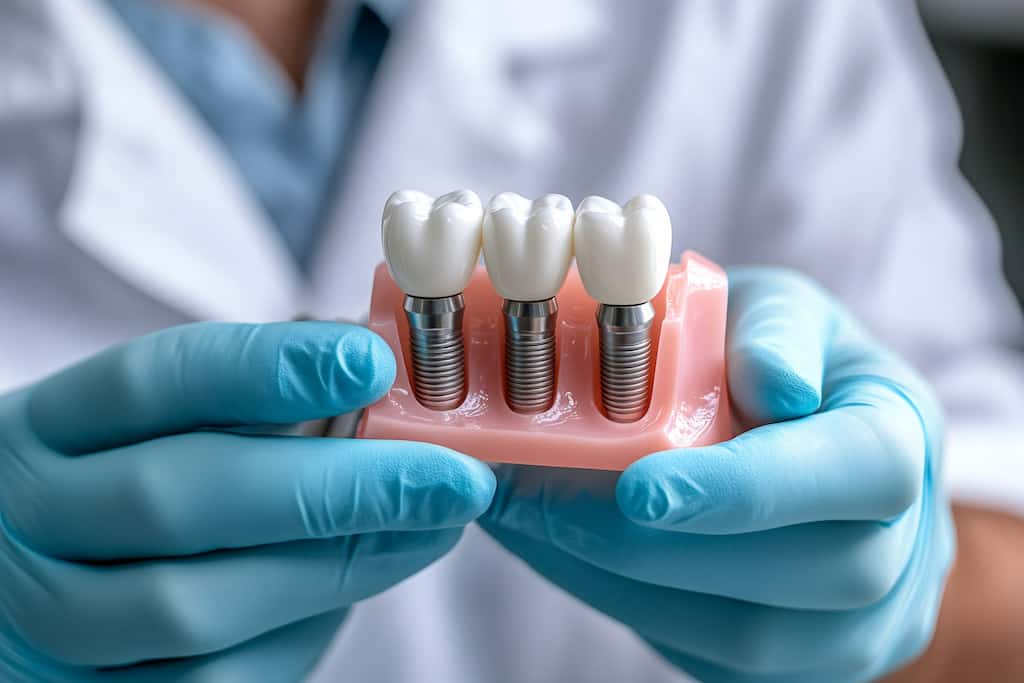
A dental implant replaces the missing tooth independently without touching adjacent teeth. The surgeon places a titanium post into your jaw bone where the tooth root used to be. This post integrates with your bone over three to six months through a process called osseointegration – the titanium actually bonds with bone tissue at a microscopic level.
After integration, you return for a second procedure to attach an abutment – a connector piece that sits between the implant post and the final crown. Your dentist takes impressions and the lab fabricates a custom crown that screws or cements onto the abutment. The result stands alone, rooted in bone, completely independent of neighboring teeth.
The neighboring teeth remain completely untouched throughout this process. No preparation, no crowns, no alteration. The implant functions as a standalone unit.
The Clinical Difference That Changes Everything
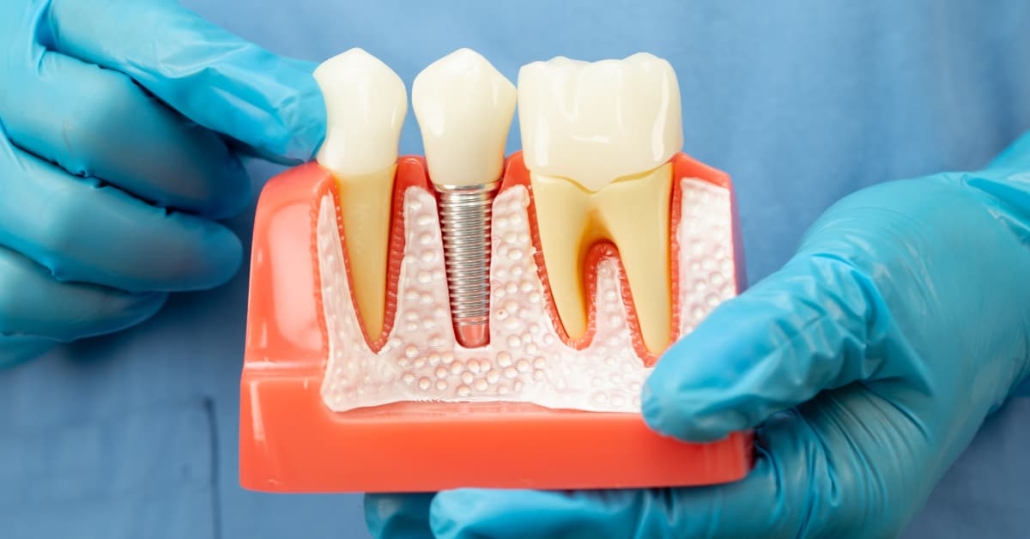
One of the most important factors in the dental implant vs bridge decision is how each option affects bone stimulation and long-term jaw health. When you chew with natural teeth, the force transfers through the tooth root into the jaw bone. This mechanical stress tells your body to maintain the bone – use it or lose it, basically.
Bridges don’t provide this stimulation under the replacement tooth. The force goes through the anchor teeth, but the bone under the missing tooth area receives no signal to maintain itself. It starts resorbing – shrinking gradually over years. This process happens slowly, but it’s continuous and irreversible with bridges alone.
Implants stimulate bone just like natural tooth roots. The force transfers through the titanium post directly into surrounding bone. This mechanical loading preserves bone volume in that area. It doesn’t prevent all bone loss – you’ll still experience some natural age-related changes – but it significantly slows the resorption that would otherwise occur.
This bone preservation difference affects long-term outcomes more than any other factor when comparing dental implants vs bridges.
The Clinical Process – What Actually Happens
Let’s walk through what each treatment actually involves from start to finish. Understanding the process helps you evaluate which fits your situation, your schedule, and your comfort level with dental procedures.
Getting a Bridge: The Two-Appointment Process
Appointment one runs about 90 minutes typically. Your dentist numbs the anchor teeth and prepares them – removing outer tooth structure to create room for the crowns. This involves drilling and reshaping. Once prepared, you receive temporary crowns to protect the teeth and maintain appearance while the lab fabricates your permanent bridge. Your dentist takes impressions or digital scans that capture the prepared teeth and surrounding structures.
You leave with temporary crowns that day. They function reasonably well but require some care – avoid very sticky or hard foods, be gentle when flossing around them. The temporaries stay in place for two to three weeks typically while the lab creates your permanent bridge.
Appointment two takes about 60 minutes. Your dentist removes the temporary crowns, tries in the permanent bridge to check fit and appearance, makes any needed adjustments, then permanently cements it in place. You leave with your final restoration that day. Total treatment time from start to finish: two to three weeks.
Recovery is minimal. Your teeth might feel sensitive for a few days after preparation, especially to temperature changes. This usually resolves within a week. Once the permanent bridge is cemented, there’s no additional healing period – you can use it normally right away.
Getting an Implant: The Multi-Month Journey
The implant process involves more steps and significantly more time. Appointment one is the surgical placement. Under local anesthesia, the surgeon creates an opening in your gum tissue, prepares a precise space in the bone using sequential drills, then places the titanium implant post. The gum tissue gets sutured closed over or around the implant. This appointment takes 60 to 90 minutes typically.
Recovery from implant surgery varies by individual. Most patients report moderate discomfort for two to three days – manageable with over-the-counter pain medication. Swelling peaks around day two or three, then gradually improves. You’ll stick with soft foods for about a week while the surgical site heals. Sutures either dissolve or get removed at a follow-up appointment after 7 to 10 days.
Then you wait. The implant needs three to six months to integrate with bone before it can support chewing forces. During this time, the titanium post bonds with surrounding bone tissue at a cellular level. You can’t rush this process – it’s biological and takes the time it takes. Most patients receive a temporary solution during healing – either a removable partial or temporary bridge – to maintain appearance and function.
After integration, you return for abutment placement. This may be a minor procedure if the implant was buried under tissue, or simply an appointment if the implant had a healing abutment visible in your mouth. The dentist attaches the permanent abutment – the connector between implant and crown – and takes impressions for your final crown.
Two weeks later, you return for crown delivery. The custom crown either screws into the abutment or cements onto it, depending on the design. Once placed, you’re done. Total treatment time from start to finish: four to seven months typically.
Dental Implant vs Bridge Timeline Comparison
When evaluating a dental implant vs bridge, treatment timeline is often a deciding factor—especially for patients with upcoming events or time-sensitive needs.
- Bridge timeline – 2 to 3 weeks from start to final restoration, 2 appointments, minimal recovery
- Implant timeline – 4 to 7 months from start to final restoration, 3 to 4 appointments, moderate surgical recovery plus extended healing period
If you need your tooth replaced quickly – you’re getting married in six weeks, starting a new job, have professional commitments requiring complete teeth – a bridge delivers faster results. If you have time for the biological healing process and prefer the long-term benefits of bone preservation, implants offer advantages worth the extended timeline.
Cost Comparison – Initial Investment and Long-Term Reality

Let’s break down what each option actually costs, not just initially but over the lifespan of the restoration. This long-term cost perspective often changes how patients evaluate the dental implant vs bridge decision—especially when factoring in replacement, maintenance, and risk to surrounding teeth.
Bridge Costs: The Full Picture
Traditional bridges typically cost $2,500 to $5,000 for a three-unit bridge replacing one tooth. Geographic location significantly affects pricing – expect higher costs in major urban centers. Material choices also matter – all-ceramic bridges cost more than porcelain-fused-to-metal versions, but many patients prefer the aesthetics of ceramic for visible front teeth.
Let’s use $3,500 as a realistic mid-range cost for our comparison. That covers both dental appointments, the lab fabrication, and temporary crowns during the fabrication period.
But the initial cost isn’t the complete story. Bridges have ongoing considerations that add expense over time. The anchor teeth now have crowns, which means they’re at increased risk for problems compared to untouched natural teeth. Decay can develop under crown margins if oral hygiene lapses. The bridge puts additional stress on anchor teeth, which can lead to structural problems or root canal needs.
Over 10 to 15 years – the typical lifespan of a quality bridge – you might encounter:
- Root canal on an anchor tooth – $800 to $1,500 per tooth if needed
- Bridge replacement – another $3,500 when the original bridge reaches end of life
- Repair work – $200 to $500 if a problem develops but doesn’t require full replacement
Many patients never experience these additional costs. Their bridge lasts 15 years without complications, they maintain excellent hygiene, and their anchor teeth remain healthy. But the risk exists, and problems with anchor teeth are the most common reason bridges fail prematurely.
Implant Costs: Breaking Down the Investment
Single tooth implants typically cost $3,000 to $6,000 from start to finish. This includes the surgical placement, the abutment, and the final crown. Let’s use $4,500 as a mid-range estimate for comparison purposes.
That higher initial investment covers several components: the titanium implant post itself ($1,000-$2,000), the surgical procedure and surgeon’s expertise ($800-$1,500), the abutment ($300-$500), and the final crown ($1,000-$1,500). Some practices bundle these costs, others break them out separately.
Additional costs might arise if your bone requires grafting before implant placement. Insufficient bone volume requires either a bone graft to build up the area or use of shorter/narrower implants if anatomy allows. Grafting adds $300 to $1,200 typically and extends the treatment timeline by several months.
Long-term costs for implants are generally lower than bridges. The titanium post rarely fails once integrated – success rates exceed 95% in healthy patients. The crown on top needs replacement every 10 to 15 years due to normal wear, costing $1,000 to $1,500. But you’re replacing one component on a stable foundation, not replacing the entire restoration.
Implants don’t put additional stress on neighboring teeth, so you’re not creating increased risk for problems with adjacent teeth the way bridges do. This is harder to quantify financially, but it matters – you’re not potentially creating future dental work needs on otherwise healthy teeth.
Dental Implant vs Bridge: 20-Year Cost Comparison
Looking at lifetime value is essential when deciding between a dental implant vs bridge, because initial cost alone rarely tells the full story. Let’s project costs over 20 years to see the complete financial picture for dental implants vs bridges:
Bridge scenario over 20 years:
- Initial bridge – $3,500
- Bridge replacement at year 12 – $3,800 (assuming some cost increase)
- One root canal on anchor tooth at year 8 – $1,200
- Professional cleanings and monitoring – included in regular dental care
- Total estimated cost – $8,500
Implant scenario over 20 years:
- Initial implant – $4,500
- Crown replacement at year 15 – $1,200
- Professional cleanings and monitoring – included in regular dental care
- Total estimated cost – $5,700
This projection assumes no major complications for either option and reasonable maintenance. Your actual costs might vary based on your oral hygiene, overall health, and whether complications arise. But over the long term, implants often prove more economical despite the higher upfront investment.
Clinical Situations That Favor Each Option

Both dental implants and bridges work successfully for single tooth replacement. But certain situations clearly favor one option over the other based on clinical factors. Let’s look at real examples to see how this plays out.
When Bridges Make More Clinical Sense
Example 1: Teeth already need crowns
Sarah lost her upper premolar in an accident. The teeth on either side both have large old fillings that are starting to fail. Her dentist recommends they’ll need crowns within the next few years regardless of the missing tooth situation. In this case, a bridge makes perfect sense – she’s addressing three problems with one restoration. The anchor teeth need crowns anyway, so using them to support a bridge doesn’t sacrifice healthy tooth structure.
Example 2: Insufficient bone for implants
Michael has been missing his molar for eight years. A CT scan reveals significant bone loss in that area – not enough volume for a standard implant without extensive grafting. He could pursue bone grafting and implant placement, which would add six months and $1,500 to treatment. Or he could get a bridge that works with his current anatomy without surgery. He chooses the bridge to avoid additional procedures and extended timeline.
Example 3: Medical conditions affecting healing
Jennifer has uncontrolled diabetes with frequent blood sugar fluctuations. Her endocrinologist and dentist agree that surgical procedures carry higher risk until her diabetes management improves. A bridge provides tooth replacement without surgery or concerns about compromised healing. Once her health stabilizes, she can always consider implants in the future if desired.
Example 4: Budget constraints with immediate need
David needs his front tooth replaced before starting a new job in three weeks. He doesn’t have time for the months-long implant process, and his budget right now allows for bridge treatment but not the higher implant investment. A bridge solves his immediate problem within his timeline and budget constraints. He can evaluate implants later if circumstances change.
When Implants Make More Clinical Sense
Example 1: Young patient with healthy adjacent teeth
Lisa is 28 and lost a tooth due to trauma. The teeth on either side are completely healthy – no fillings, no problems, perfect structure. Preparing these teeth for crowns means permanently removing healthy tooth structure from teeth that could last her entire lifetime untouched. An implant replaces the missing tooth without altering her healthy adjacent teeth. Given her age and the health of neighboring teeth, an implant preserves more of her natural dentition long-term.
Example 2: Already missing adjacent tooth
Robert is missing his first molar. The tooth behind it is also missing. A bridge needs healthy anchor teeth on both sides – he only has one viable anchor tooth. His options are either a removable partial denture or an implant. The implant provides a fixed solution without relying on adjacent teeth for support.
Example 3: High risk for anchor tooth problems
Patricia has a history of decay and has already needed root canals on multiple teeth. Her dentist is concerned that using her teeth as bridge anchors creates additional risk – the crowned teeth will be harder to monitor for decay and the added stress might compromise teeth that are already vulnerable. An implant avoids putting her at-risk teeth under additional stress and leaves them accessible for future care if needed.
Example 4: Long-term value prioritized
Tom is 45, in excellent health, maintains meticulous oral hygiene, and wants the solution that serves him best over the next 40+ years. He has adequate bone, healthy adjacent teeth, and can afford the higher upfront investment. An implant offers superior longevity, preserves bone, and doesn’t put stress on neighboring teeth – all factors that matter for someone planning decades ahead.
Maintenance and Long-Term Care Reality
Both options require ongoing care, but the nature of that care differs. Understanding the maintenance reality helps you choose the option that fits your lifestyle and habits.
Bridge Care Requirements
Daily care for bridges involves normal brushing but requires special flossing technique. You can’t floss between the bridge units since they’re connected. Instead, you use floss threaders – devices that help you guide floss under the replacement tooth to clean the gum tissue beneath it. This adds a couple extra minutes to your routine.
Many patients find water flossers more convenient for bridge care. These devices shoot pressurized water to clean under the bridge and around the margins. Either approach works, but you need to commit to thorough daily cleaning or risk developing decay or gum disease around the bridge.
Professional cleanings should happen every six months like normal dental maintenance. Your hygienist pays special attention to the bridge margins – the area where crown meets natural tooth structure – since this is where problems typically start if they develop. Your dentist examines the bridge at each visit to check for any looseness, decay, or structural issues.
Bridges typically last 10 to 15 years with good care. Failure usually stems from problems with anchor teeth – decay developing under a crown margin, fracture of an anchor tooth, or root canal needs. The bridge itself (the prosthetic unit) rarely fails structurally if well-made.
Implant Care Requirements
Daily implant care closely mirrors natural tooth care. You brush normally with a soft-bristle brush. You floss normally around the implant crown – no special techniques needed since the implant stands alone like a natural tooth. Some dentists recommend special interdental brushes for the area where crown meets gum, but this is typically optional.
The key difference is that poor hygiene around implants can lead to peri-implantitis – inflammation and infection around the implant that threatens its stability. This condition mirrors gum disease but affects implants specifically. Prevention requires thorough daily cleaning, which most patients handle easily if they already maintain good oral hygiene.
Professional cleanings happen every six months typically, possibly more frequently if you have a history of gum disease. Your hygienist uses special instruments around implants – metal scalers can scratch the titanium or abutment surface, so plastic instruments are preferred. Your dentist checks the implant stability, examines surrounding tissue, and evaluates bone levels through periodic X-rays.
Implants can last 25+ years, with many lasting a lifetime if well-maintained. The crown on top typically needs replacement every 10 to 15 years due to normal wear, but the implant post itself rarely fails once established. Failure, when it occurs, usually relates to poor oral hygiene, smoking, uncontrolled diabetes, or inadequate bone quality at placement.
Making Your Decision Between a Dental Implant vs Bridge

You’ve now seen the clinical differences, cost realities, and specific situations that favor each option when comparing dental implants vs bridges. Both approaches successfully replace missing teeth for millions of patients. Neither is universally “better” – they’re different tools appropriate for different circumstances.
Start by evaluating your adjacent teeth. If they’re pristine and healthy, preserving them untouched carries significant value – implants avoid altering healthy tooth structure. If they already have large fillings or need crowns anyway, a bridge efficiently addresses multiple needs simultaneously.
Consider your timeline. If you need your tooth replaced within a month – upcoming wedding, new job, professional commitments – bridges deliver results faster. If you have four to six months available for treatment, implants become feasible and offer long-term advantages.
Assess your bone situation. If you’ve been missing the tooth for several years, bone loss has likely occurred. A clinical examination and CT scan reveal whether you have adequate bone for an implant or would need grafting first. Bridges work regardless of bone volume.
Factor in your health status. Uncontrolled diabetes, smoking, certain medications, and immune conditions can affect implant success. If you have health concerns that compromise healing, bridges provide predictable results without surgical risks.
Evaluate your budget reality and insurance coverage. Bridges typically cost less initially and receive better insurance coverage. Implants require higher upfront investment but often cost less over 20+ years. Determine what you can afford now versus what serves you best long-term.
Think about your oral hygiene habits honestly. Both options demand consistent daily care. Bridges require special flossing techniques. Implants need thorough brushing and flossing similar to natural teeth. Poor hygiene threatens both solutions – choose the care routine you’ll actually maintain.
Here’s a decision framework many patients find helpful when deciding on a dental implant vs bridge solution:
- Choose a bridge if – adjacent teeth already need crowns, you need fast treatment, you have bone loss without wanting grafting, health conditions increase surgical risks, or initial budget is primary concern
- Choose an implant if – adjacent teeth are healthy, you have adequate bone, you prioritize long-term value, you want to avoid stressing neighboring teeth, or you have time for the extended treatment process
Get a thorough clinical evaluation before deciding. That means examination of adjacent teeth, assessment of bone volume (often with CT scan), review of your medical history, and discussion of your priorities. A dentist who offers both options can explain which makes sense for your specific case without bias toward one approach.
The dental implant vs bridge decision affects your oral health, bone stability, and overall dental costs for years—sometimes decades—to come. Take time to understand both options fully. Ask questions about anything unclear. Choose based on your actual clinical situation and priorities, not generic recommendations or what worked for someone else. The right choice is the one that addresses your needs, fits your circumstances, and gives you confidence in your smile.
If you’re ready to evaluate a dental implant vs a bridge with a team that provides unbiased, patient-focused guidance, Optima Dental Surgery Center offers comprehensive consultations throughout Austin, Round Rock, and Temple. We’ll examine your clinical situation thoroughly, explain which options make sense for your case, discuss all costs transparently, and support whichever choice you make. Schedule a consultation to get clarity on the right solution for your smile.
Frequently Asked Questions: Dental Implant vs Bridge
What’s the main difference in a dental implant vs bridge?
A dental implant vs bridge comparison comes down to how the replacement tooth is supported. A bridge relies on the two neighboring teeth (which are reshaped to hold crowns), while an implant replaces the tooth independently by placing a titanium post in the jawbone and attaching a crown on top.
Does a dental implant vs bridge affect the healthy teeth next to the missing tooth?
Yes. With a bridge, the teeth on either side of the gap are permanently altered to support the restoration. With an implant, adjacent teeth typically remain untouched because the implant stands alone as its own “root” and crown.
In a dental implant vs bridge, which option helps preserve jawbone?
Implants generally preserve jawbone better. In a dental implant vs bridge decision, this is a major clinical factor: implants transfer chewing forces into the bone (similar to natural roots), helping maintain bone volume. Bridges don’t stimulate the bone under the missing tooth area, so gradual bone loss can occur over time.
How long does treatment take for a dental implant vs bridge?
A bridge is usually completed in about 2–3 weeks over two appointments. A dental implant vs bridge timeline is longer for implants because healing and bone integration take time—often 4–7 months total, with multiple steps (surgery, healing, abutment, crown).
What does a dental implant vs bridge cost, and which is cheaper long-term?
Upfront, bridges often cost less and may have better insurance coverage. Implants typically cost more initially, but over the long term a dental implant vs bridge analysis often favors implants because bridges may need full replacement and can create added risk/cost for the anchor teeth. Implant crowns may need replacement eventually, but the implant “foundation” often lasts much longer.
Who is a better candidate for a dental implant vs bridge
A bridge may be a better fit if adjacent teeth already need crowns, you need a faster solution, you have significant bone loss and want to avoid grafting, or health conditions make surgery riskier. An implant may be ideal if adjacent teeth are healthy, you have adequate bone, you want to preserve bone and avoid stressing nearby teeth, and you can accommodate the longer treatment timeline.