If you are weighing dental implants vs dentures cost, you are asking two things. What does each option cost now, and what will it ask of you over the years in upkeep, eating, and daily comfort? This guide answers both, using published prices and the research behind each figure.
Quick answer. Dentures cost less up front, and over the periods Canadian, Swiss and Italian cost studies measured. Full traditional dentures average $2,022 nationally in the 2026 Synchrony cost study. In return, implants give fixed or steadier teeth, and a 2018 review found better chewing and higher satisfaction with lower dentures on two implants. Our full-arch price page puts a typical All-on-4 arch at $20,000 to $28,000, and your quote comes at a free consultation.
The first estimate shows only what treatment costs at the start. It does not tell you how often you will need repairs or which foods may become harder to eat. It also leaves out how the bone ridge under a denture keeps shrinking, which slowly loosens the fit.
In my exam room at Optima Dental Surgery Center, a price-only comparison does not hold up for long. Dentures rest on the gums, while implants are placed in the jawbone. That difference means the choice turns on your health history, daily habits, budget, and how you feel about surgery.
So below I compare the parts patients ask me about after they leave the consultation room. The comparison runs from daily comfort, eating, care, and repairs for each option to what published cost studies found over the periods they measured.
The figures come from a 2019 meta-analysis of 18 prospective implant studies and a 2021 review of 42 complete-denture studies, mostly in university settings.
The Difference Between Implants and Dentures
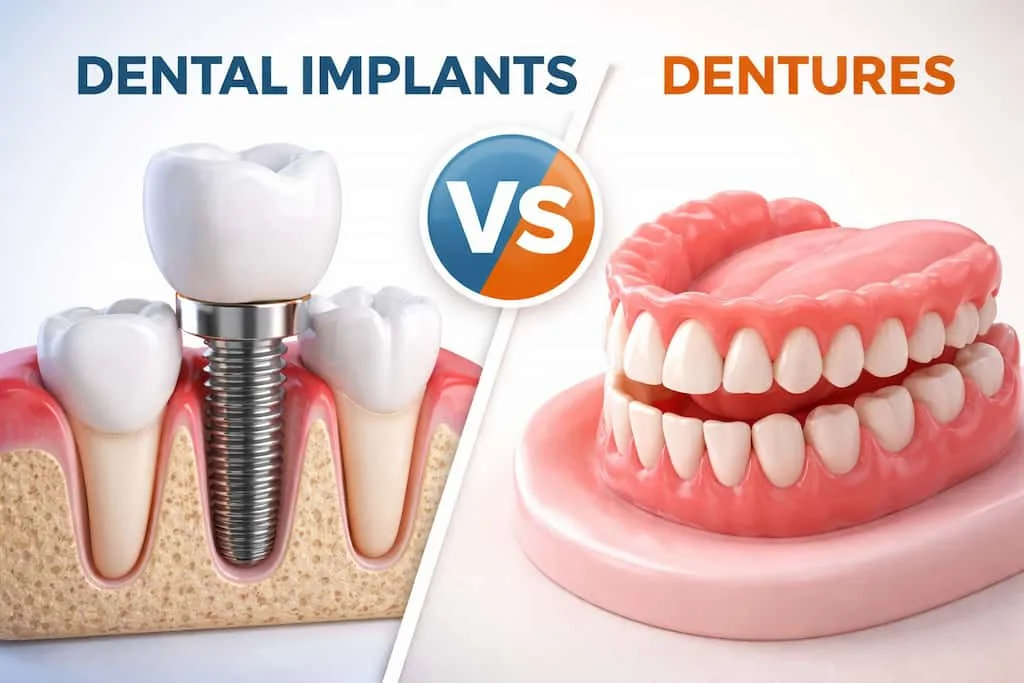
Most people think they are comparing two types of replacement teeth, but the difference goes deeper than that. You are comparing two completely different approaches to tooth replacement. One sits on your gum tissue, and the other anchors into your jaw bone. This distinction is why the dental implants vs dentures cost question never has a one-line answer.
Dentures are removable prosthetics that rest on your gum tissue. The American College of Prosthodontists (ACP) says a close fit, well-shaped borders, a thin film of saliva, and air pressure hold them in place. You take them out at night to clean and soak them, and some people use adhesive for extra hold. About 90% of Americans with no teeth have dentures, the American Dental Association (ADA) reports.
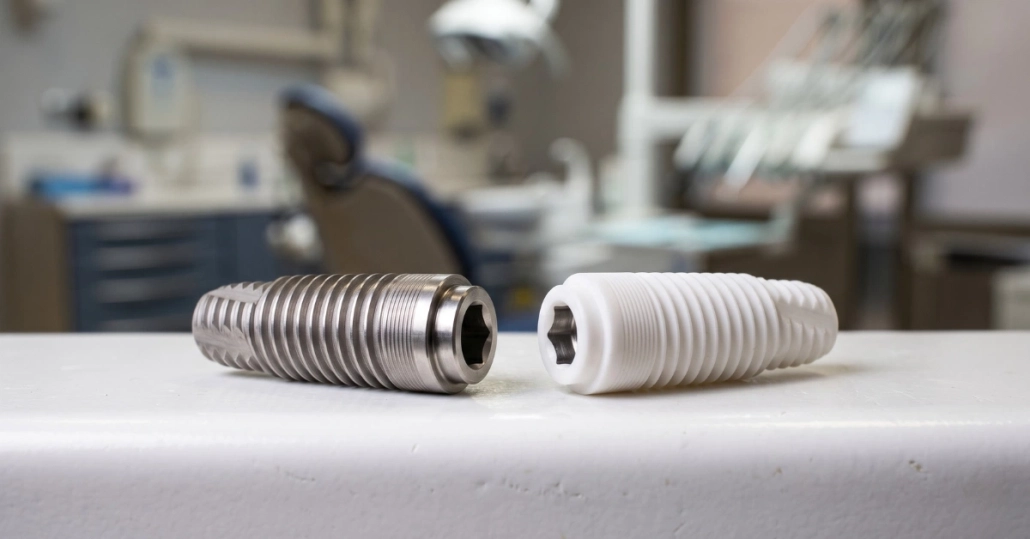
A dental implant is a post that a surgeon places in your jaw to support replacement teeth. The FDA says most implants are made of titanium or zirconium oxide, and each may take several months or longer to heal. Once healed, the implant can hold teeth that screw or cement into place and stay fixed.
Patients often bring in the same misconception, that dentures are just cheaper implants. That misses how the two treatments work. They are different solutions with different mechanisms, different care requirements, and different long-term outcomes. Choosing between them means matching the treatment to your health, bone structure, budget, and goals.
Another common belief, that implants never wear out and dentures fall apart fast, overstates both sides. Dentures wear with use, and the ACP’s denture replacement position statement calls for an evaluation after more than 5 years. A 2021 review of mostly university-made dentures put their average life at 10.1 years. Implants can fail too, and the FDA flags smoking and uncontrolled diabetes and calls regular cleaning very important.
Under a denture, the bone ridge shrinks most in the first 3 to 12 months after teeth come out, then more slowly for life. The denture then fits less closely. The FDA’s guide to dental implants lists helping keep the jawbone from shrinking among their benefits. Another 2021 review, though, found no significant difference in rear lower-jaw shrinkage between regular dentures and dentures held by two implants.
Dental Implants vs Dentures Cost Compared Side by Side
Start with the factors patients weigh beyond the first price quote. I explain each row in more detail in this guide.
Implant prices are Optima Dental Surgery Center’s published ranges. Each case is quoted individually. Denture prices are national, from the 2026 Synchrony Average Procedural Cost Study published by CareCredit. Other rows cite ACP, ADA, FDA, NIA, and peer-reviewed studies.
Use the table as a quick reference. Numbers alone do not settle the choice, because what you live with is how each option feels at meals, in conversation, and overnight. The comfort section below covers that in detail.
Daily Comfort With Implants and Dentures
Comfort shows up during normal life first. I mean breakfast, work meetings, sleep, and the small moments when you do not want to think about your teeth.
Eating With Implants vs Dentures
Chewing works differently with dentures. Most studies in a 1990 summary put denture wearers at about one fifth to one fourth of the bite strength of natural teeth. The National Institute on Aging (NIA) adds that dentures can make it harder to feel hot foods and drinks. It suggests starting with soft foods that are not sticky.
Implant overdentures are removable dentures held by implants. Studies from 2000 and 2021 found their bite force falls between regular dentures and natural teeth. A 2007 review, rating its evidence as moderate, reported that fixed implant lower dentures improved chewing for people dissatisfied with their dentures.
Speaking and Daily Confidence
According to the ADA, a new denture may feel loose at first while your cheek and tongue muscles learn to keep it in place. In a 2018 review, lower dentures held by two implants scored higher than regular dentures for speech and stability.
Sleeping and Overnight Comfort
Dentures come out overnight for a reason. The NIA’s guide to teeth and mouth care advises soaking them at night and leaving them out while you sleep to prevent swollen gums. When they are out, the ADA says to keep them covered in water so they do not warp.
A 2016 guideline from four US dental groups says snap-in dentures on implants also come out during sleep and go in a cleaning solution. Fixed full-arch implant teeth are non-removable, so you sleep and wake up with them in place.
Physical Sensation and Adaptation
The ADA says new dentures may feel awkward for a few weeks. Some things are harder to feel with dentures in, and the NIA names bones or other hard bits in food. The 2018 review cited above also found higher comfort ratings with the two-implant lower denture.
Confidence in Social Situations
Confidence around other people is personal. Still, a 2009 consensus statement concluded that satisfaction and quality of life are significantly greater with implant-held lower dentures than with regular dentures. A 2026 analysis of 21 randomized trials found implant overdentures consistently linked to better patient-reported and functional outcomes, though findings varied widely between trials.
Those gains come with a tradeoff. Implants need surgery, and healing can take several months or longer, the FDA says. They also cost more, both up front and over time, in published cost studies from Canada, Switzerland and Italy that compared them with dentures.

Not sure which option fits you? Book a free consultation at our Round Rock office, or a free 15-minute phone consultation. Our team sets your options side by side, including All-on-4 and Stabili-Teeth™, so you can weigh cost against how long each one lasts. Implant planning uses 3D imaging.
Maintenance at Home and in the Dental Chair
Implants and dentures require different daily care and checkup schedules. The routines below show what you would do at home and how often each option needs professional care.
Daily Care for Each Option
The two routines ask different things from you. Here is what each looks like in practice.
Fixed implant teeth are cleaned in place, and the American Academy of Periodontology says brushing and flossing are still necessary. Denture care covers your gums as well as the dentures. You brush them each morning before the dentures go in, and the National Institute on Aging advises sleeping with dentures out to prevent swollen gums.
Professional Maintenance and Monitoring
For dentures, the American College of Prosthodontists (ACP) advises a dental check every year. The ACP says no evidence sets how often a denture needs a reline, rebase or remake, and that a thorough exam should decide. Once a denture has been in use for more than 5 years, the college adds, it should be evaluated for replacement.
Implant teeth come with a different checkup schedule. A 2016 US guideline from the ACP, the ADA and two other dental groups advises an exam at least every 6 months for life. It calls for adjusting, repairing or replacing any part as needed. A fixed full-arch bridge should come out for professional cleaning only if you cannot clean it well yourself.
A 2026 review drawing on seven earlier reviews of full-arch implant bridges put screw loosening at 5% to 15%. Veneer chipping ran 15% to 35% on veneered zirconia bridges. Another review, from 2012, covered 281 of these bridges and found that complications keep occurring over time, from fatigue and stress.
Repairs Over Time
The FDA says bone shrinkage gradually loosens dentures, which should then be relined or remade. A reline adds new base material to the side that sits on your gums. A rebase replaces the whole base in a lab. An immediate denture, fitted the day teeth come out, may need a reline or remake once the jaw heals, the ADA notes.
Implant complications can come soon after placement or much later, the FDA says, and a loosened screw can feel like a loose or twisting tooth. If an implant feels loose or painful, the agency advises telling your dental provider right away. Even complications that do not cause failure cost repair time and money, the 2012 review found. The 2026 review put peri-implantitis at 4% to 18%.
Upfront and Ongoing Cost of Dentures and Implants
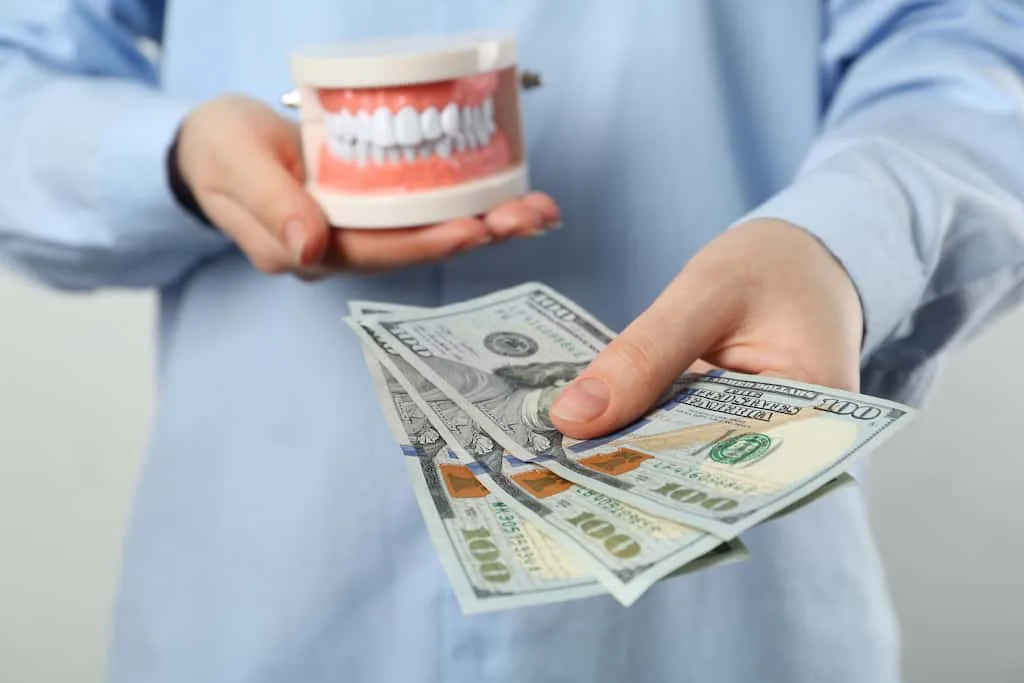
The starting fee is only one line of the bill. Both options bring checkups, relines or repairs to worn parts and, in time, a new denture or, for some, a remade bridge. Neither option is a one-time cost.
Denture Costs at the Start and Over Time
The 2026 Synchrony Average Procedural Cost Study, published by CareCredit, puts full traditional removable dentures at a national average of $2,022. The range runs from $1,493 to $3,309, and the Texas average is $1,995. A dental exam with X-rays averages $210 nationally. After that, upkeep adds a yearly dental check and any reline or rebase that an exam calls for.
Older adults face the same price range, but health, bone levels, and monthly budget may change the choice. Full traditional dentures average $2,022 nationally. Optima’s All-on-4 price usually runs $20,000 to $28,000 per arch. Original Medicare covers neither option in most cases, so compare the treatment fee, expected upkeep, and available plan benefits before you choose.
The ACP advises evaluating a denture for replacement after 5 years of use. A review of 42 studies found complete dentures lasted 10.1 years on average, though most were made in university settings. Properly fitted dentures should not need adhesive in most cases, according to the FDA. If needed, a 2.4-ounce tube for both dentures should last seven to eight weeks.
Implant Prices and the Upkeep That Follows
At Optima Dental Surgery Center, All-on-4 usually runs $20,000 to $28,000 per arch, and Stabili-Teeth™ runs $12,500 to $15,000 per arch. All-on-6 or All-on-X cases typically run $25,000 to $32,000 for the upper arch and $23,000 to $28,000 for the lower. Each case is quoted individually. At the free consultation, our team sets the options side by side so you can weigh cost against how long each lasts.
Nationally, the same 2026 study puts full implant-supported dentures, fixed or removable, at $4,093 per implant on average. The per-implant range is $2,830 to $7,203. After placement, upkeep means an exam at least every 6 months for life, with parts adjusted, repaired or replaced as needed. Repairs for complications that come up over the years add to that.
What Long-Term Cost Studies Found
Dentures are cheaper. Published studies that compared an implant option with conventional dentures found the implant option cost more over the period each one measured. One 2005 analysis drew on a Canadian trial at McGill University with 30 patients in each group. Over an assumed 17.9 years, yearly costs came to 399 Canadian dollars for a conventional lower denture and 625 Canadian dollars for a two-implant overdenture.
In a 2013 review of 14 studies, most judged implants for a toothless lower jaw cost-effective over the long term. Cost-effective means more benefit per dollar, not a lower total. Satisfaction and quality of life were significantly greater with implant lower overdentures than with conventional dentures, a 2009 UK consensus statement said. A 2018 review of 26 articles found better chewing and oral-health quality of life with two-implant lower overdentures.
Our team works with financing companies including CareCredit, Cherry and LendingClub. Terms and approval depend on your credit and other factors, and you can apply to more than one lender to compare offers. Details are on our dental implant financing options page. For the treatment itself, see our complete guide to dental implants.
Time and Other Costs Beyond the Fee
A conventional denture goes in once the gums heal after extractions, which the ADA says may take several months. An immediate denture goes in the same day, though it may need a reline or remake after the jaw heals. Healing around an implant may take several months or longer, the FDA notes. Even so, with All-on-4, patients leave our Round Rock office the same day with a full, functional smile.
Common Misconceptions About Both Options
Making Your Decision Between Implants and Dentures
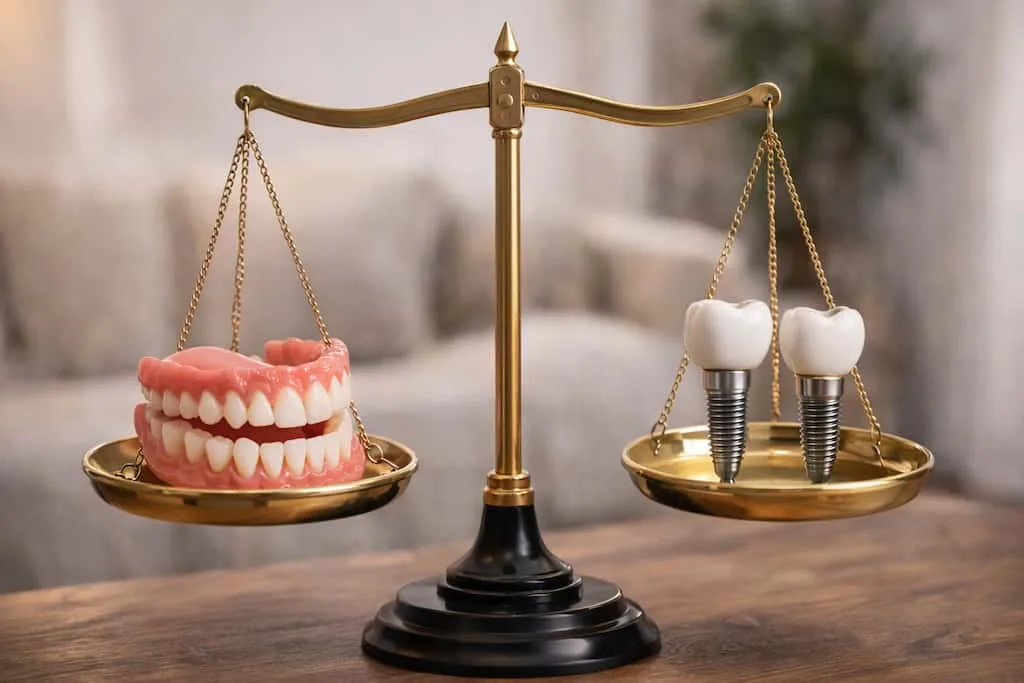
Rank what matters most to you before you compare procedures, and the choice gets easier. If eating comes first, implants deserve a close look. A review of 26 articles found significantly better chewing with two-implant lower overdentures than with conventional dentures. If budget leads, dentures cost less at the start, and studies from Canada, Switzerland and Italy found them cheaper over the period each measured.
For fixed teeth that generally cost less than All-on-4, look at Stabili-Teeth™, our same-day fixed full-arch system. It uses 6 to 8 implants per arch. Bone is the third concern, and the FDA lists helping keep the jawbone from shrinking among the benefits of implants. For limited bone, the options later in this section include grafting, All-on-4 and, for selected patients, zygomatic or pterygoid implants.
I put All-on-4, All-on-X and Stabili-Teeth™ in a different category from a removable denture, because those teeth are fixed. Snap-in dentures, also called implant overdentures, attach to implants and come out for cleaning. A 2012 review calls the two-implant lower overdenture the minimum standard of implant care, the level it judged sufficient for most people. Our guide to snap-in dentures covers their cost and care.
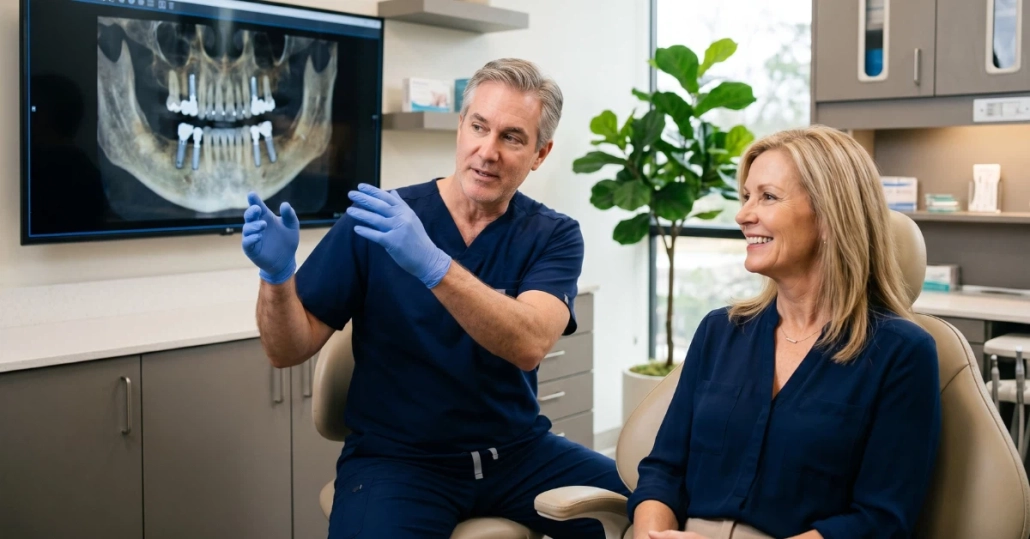
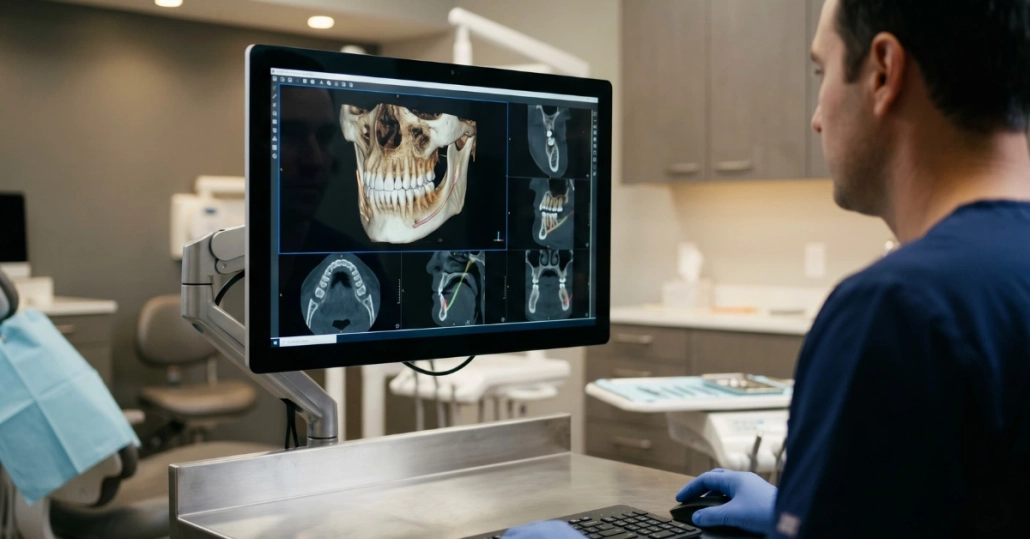
Before you choose, use your consultation to get a clear picture of your mouth and your health. Imaging shows the bone you have to work with, and a health review flags anything that could affect healing. Ask to see each option’s starting price and upkeep side by side, and ask for a recommendation that fits your life outside the chair.
At Optima Dental Surgery Center, our team provides single implants, full-arch All-on-X treatment, bone and soft tissue grafting, and Stabili-Teeth™ placement. Our office is at 990 Hesters Crossing Rd in Round Rock. From there we serve patients in Round Rock, Austin, Waco, Lakeway and across Central Texas.
Implant Options When Upper Jaw Bone Is Limited
Standard implants need adequate jawbone to hold them. When the upper jaw has less bone, grafting can build up the jaw ridge or raise the sinus floor to make room for implants. In most All-on-4 cases, four angled implants carry the full arch with no bone grafting or sinus lift. For selected patients, zygomatic or pterygoid implants are two more options, explained below.
Standard candidates
Traditional Implants
Placed directly into existing jawbone. Needs adequate bone at the implant site to support it. In-bone implants like these are the most common type, according to the American Academy of Periodontology.
Same-day teeth
All-on-4
Four angled implants carry a full arch of fixed teeth, in most cases with no bone graft or sinus lift. Patients leave the same day with a full, functional smile. Read more about All-on-4 teeth in a day.
Cheekbone anchor
Zygomatic Implants
Anchored in the cheekbone (zygoma) instead of the upper jaw ridge. A 2026 review says these implants can reduce the need for extensive grafting in selected patients with severe upper-jaw bone loss.
Alternative anchor site
Pterygoid Implants
Angled back so the tip anchors in the pterygoid process of the sphenoid bone. In a 2023 review, most of the implants studied supported fixed full-arch bridges.
When some bone remains, the 2026 review on zygomatic implants also advises weighing less invasive options, such as short or tilted implants. In a 2016 review, their main complication was sinusitis, which can show up years after surgery. If grafting is your path, start with our bone grafting for implants guide. Our overview of bone grafting explains what it involves.
For implants in general, a 2019 meta-analysis of 18 prospective studies put 10-year survival, meaning the implant is still in place, at 96.4%. For zygomatic implants, the 2016 review put 12-year cumulative survival at 95.21%, with most failures in the first 6 months. A 2023 review found 95.5% cumulative survival at 6 years for pterygoid implants with roughened surfaces.
Questions to Ask Before You Choose
- How much bone do I actually have? Ask to see your own 3D scan, not just a verbal estimate.
- Am I a grafting candidate, or do I need zygomatic or pterygoid placement? These are different procedures with different timelines.
- What recurring costs should I expect over the years? Ask about relines, checkups, worn parts, and when a replacement may be due.
- What happens if the first attempt does not integrate? Ask about the practice’s revision policy before you commit.
- Who is actually performing the surgery? Ask for the surgeon’s specific credentials in the procedure you are considering.
The figures in this guide are a starting point, and your own quote depends on your case and the option you choose. At a free consultation in our Round Rock office, Dr. Owens and his team set each option side by side. You can then weigh what each one costs against how long it lasts.