You’ve done your research. You’ve read about titanium and zirconia, seen ads for All-on-4 and Stabili-teeth®, and now you’re more confused than when you started. That’s not a failure of effort – it’s a predictable result of a market where every system has its own name, its own claims, and very little context for what actually applies to your situation.
I’ve sat across from hundreds of patients in this exact position. The question isn’t just “which type of dental implant exists” – it’s “which type makes sense for someone with my bone, my health, and my goals.” This guide answers that. You’ll get a clear breakdown of the different types of dental implants – by material, by placement method, and by arch system – along with a decision framework built for adults 50 and older weighing these options seriously. Cost context is included throughout, with conditional language where it belongs.
What Are the 3 Types of Dental Implants? (And Why That Question Is Incomplete)
When people ask “what are the 3 types of dental implants,” they’re usually looking for a simple answer. The clinical reality is that dental implants are categorized three ways at once – by material, by how they’re placed in the jaw, and by how many teeth they support.
Here’s a quick orientation:
- By material: Titanium or zirconia (ceramic)
- By placement type: Endosteal (in the bone) or subperiosteal (on the bone)
- By arch system: Single tooth, implant bridge, or full-arch replacement
Each category answers a different question. Material tells you what the post is made of. Placement type tells you how it’s anchored in your jaw. Arch system tells you how many teeth it replaces and how. A complete picture of your options requires understanding all three – which is what the sections below cover in order.
Part 1: Dental Implant Materials – Titanium vs. Zirconia
The implant post – the piece that goes into your jawbone – is made from one of two materials. Which material your surgeon recommends depends on your anatomy, your health history, and what the final restoration needs to accomplish.
| Feature | Titanium | Zirconia (Ceramic) |
|---|---|---|
| Material | Metal alloy | Ceramic (metal-free) |
| Clinical Track Record | Decades of long-term data | Shorter history, growing evidence base |
| Appearance | Silver-grey (typically covered by gum tissue) | White throughout – no grey visible through gums |
| Design Flexibility | Wide range of sizes and angles | Mostly one-piece; limited angulation options |
| Best For | Complex cases, full-arch systems, angled placement | Single teeth, metal-sensitive patients, thin gum tissue |
| Typical Cost Range | Generally comparable; varies by case complexity | Will cost more |
Titanium Dental Implants
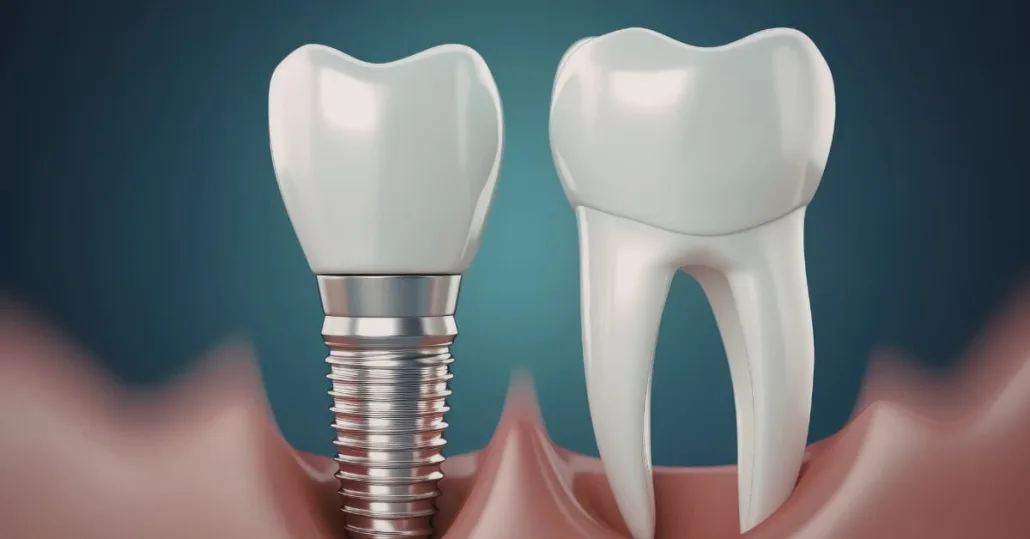
Titanium has been used in medical implants for decades. It became the standard in implant dentistry because of how predictably it integrates with human bone – a process called osseointegration. The body doesn’t reject it the way it might reject a foreign material. According to the American Dental Association, titanium remains the most widely used material for dental implant posts due to its biocompatibility and long-term integration data.
Titanium dental implants come in a wide range of diameters, lengths, and surface textures. That flexibility is a clinical advantage when anatomy is complicated – cases with bone loss, cases requiring angled placement, or full-arch restorations that need to span an entire jaw. At Optima, we work with several titanium implant systems for cases where bone volume and integration quality are primary considerations.
Titanium works well when: you need a full-arch system, your case involves significant bone loss, angled placement is required, or you want the most established clinical track record available.
Zirconia (Ceramic) Dental Implants
Zirconia implants are a metal-free alternative. The material is white throughout, which matters aesthetically when gum tissue is thin or has receded – the grey of a titanium post won’t show through. Zirconia is also non-conductive and doesn’t corrode, which some patients with metal sensitivities find reassuring.
The tradeoff is less flexibility. Zirconia dental implants are typically one-piece designs, which limits angulation options during placement. They’re not available in the same range of sizes. For straightforward single-tooth replacements where the patient prefers a metal-free option, zirconia is a reasonable path. For complex full-arch cases, titanium remains the more adaptable material.
Zirconia works well when: you’re replacing a single tooth, gum tissue is thin or receding, you have a documented sensitivity to metals, or avoiding metal is a personal priority.
Our ceramic and zirconia implant options page covers this material choice in more detail, including what patient scenarios it’s designed for.
Part 2: Dental Implant Placement Types – Endosteal vs. Subperiosteal
Beyond material, dental implants differ in how they anchor to your jaw. This is where the classification “types of dental implants” gets technical – but it matters because your bone condition determines which placement type is even an option.
Endosteal Dental Implants (Into the Bone)
Endosteal implants are the standard type used in the vast majority of cases today. The post is inserted directly into the jawbone, where it integrates with the surrounding bone over a period of weeks to months. Once integration is complete, the abutment and prosthetic crown, bridge, or arch attach to the top.
Endosteal implants require sufficient bone volume and density to anchor the post securely. The bone must be wide enough, tall enough, and healthy enough to support the implant through the integration process and long-term loading. When bone volume is borderline, bone grafting can often rebuild enough structure to make endosteal placement viable.
This is the placement type behind single-tooth implants, implant-supported bridges, All-on-4, All-on-X, and Stabili-teeth® – in other words, the foundation of virtually all modern dental implant treatment.
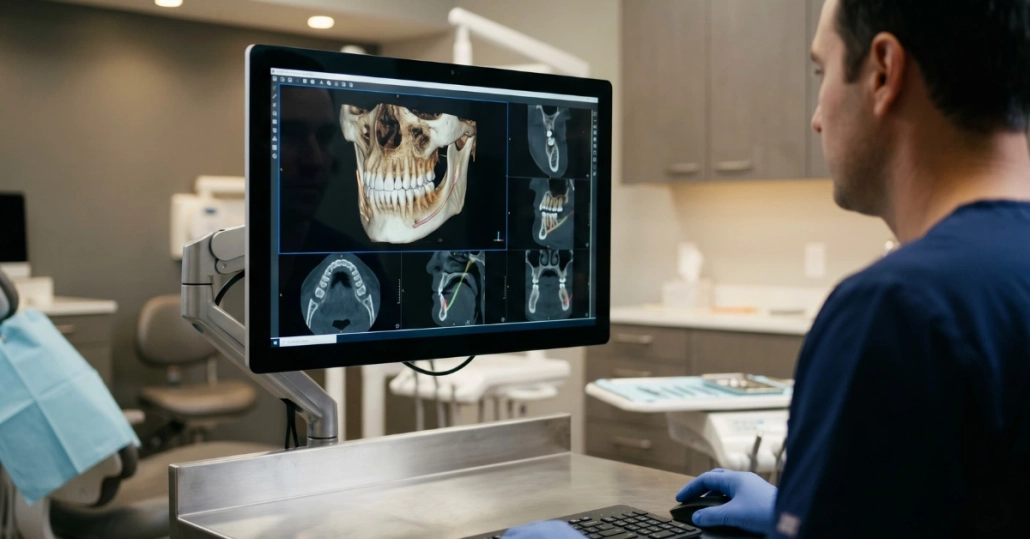
Endosteal placement requires: adequate bone width and height, healthy jawbone tissue, and – in many full-arch cases – a 3D cone beam CT scan to map bone volume before placement is planned.
Subperiosteal Dental Implants (On the Bone)
Subperiosteal implants sit on top of the jawbone, beneath the gum tissue, rather than inside it. A custom metal framework is fabricated to fit the contour of your jaw, and posts protrude through the gum to support a prosthetic.
This approach was developed specifically for patients with severe bone loss who don’t have enough jawbone volume to anchor an endosteal post – even after grafting. It’s far less commonly placed today than it was decades ago, because advances in bone grafting techniques and angled implant placement have made endosteal options viable in many cases that previously would have required subperiosteal solutions.
Subperiosteal implants remain a consideration for patients with extensive bone loss where endosteal placement and grafting are not viable. If your situation involves severe jaw atrophy, your surgeon will discuss whether this applies to your case.
Subperiosteal may be considered when: bone loss is severe and extensive, bone grafting is not a viable path, and a fixed or semi-fixed solution is still desired. This is a relatively rare clinical scenario today.
Why This Matters for You
Nearly all patients today receive endosteal implants. Whether you have enough bone for endosteal placement – and whether grafting is needed first – is exactly what a 3D cone beam CT scan determines. Understanding what factors affect whether you’re a candidate for dental implants is a useful read before your appointment.
Part 3: Dental Implant Arch Systems – From Single Tooth to Full Arch
The third way dental implants are categorized is by how many teeth they replace and how the prosthetic is supported. This is the section most patients are actually trying to understand when they research different types of dental implants – because this is where cost, complexity, and lifestyle impact diverge most significantly.
The progression below moves from simplest to most involved. Each option has a corresponding cost range, but those figures are conditional – what you’ll pay depends on how many implants are placed, whether bone grafting is needed, the material used for the final prosthetic, and your specific anatomy.
Single-Tooth Dental Implants
A single-tooth implant replaces one missing tooth with one post, one abutment, and one crown. No neighboring teeth are altered. The post integrates with the jawbone and preserves bone at the site – bone that continues to shrink if nothing replaces the root.
- Best for: One or two isolated missing teeth with healthy neighboring teeth and adequate bone
- Cost context: Typically $3,000 to $6,000 per tooth, conditional on bone condition, location, and types of dental implants materials used for the crown. Extractions or grafting increase the total.
If you’re weighing a single implant against a dental bridge, our article on how a single implant compares to a traditional bridge covers the clinical tradeoffs.
Implant-Supported Bridges
When two or more adjacent teeth are missing, an implant-supported bridge replaces the entire gap using two implants placed at either end – typically supporting three to four visible teeth with two posts. This preserves more bone than a traditional cemented bridge without requiring an implant at every position.
- Best for: Two to four consecutive missing teeth in one area
- Cost context: Typically $5,000 to $15,000+, varying considerably by number of teeth replaced, materials, and whether grafting is required.
For a broader comparison of all tooth replacement options, our full tooth replacement options overview is a useful reference.
Implant-Supported Dentures
Implant-supported dentures use two to four implants to anchor a removable denture in place. The denture snaps onto the implants and stays secure during eating and speaking – but is still removed for cleaning. This is a meaningful distinction from the fully fixed arch systems covered next.
- Best for: Patients who want significantly more stability than a conventional denture but prefer a removable option, or who lack the bone volume for a fully fixed arch
- Cost context: Typically $3,500 to $30,000+, highly variable depending on implant count, arch (upper vs. lower), and whether the denture is new or existing.
Our snap-in and implant-supported denture guide covers the mechanics and patient scenarios in detail.
All-on-4 and All-on-X Full-Arch Dental Implants
All-on-4 is a trademarked protocol using four implants to support a full fixed arch – two placed vertically toward the front, two angled toward the back. The angling reaches denser bone further back in the jaw, often without requiring bone grafting.
All-on-X describes full-arch cases where implant count varies by bone anatomy and clinical judgment – six, eight, or more posts may be used. The prosthetic – typically acrylic or zirconia – is fixed and non-removable.
- Best for: Patients missing most or all teeth in an arch who want a fixed, non-removable result
- Cost context: Typically $20,000 to $50,000+ per arch, conditional on implant count, prosthetic material, extractions needed, and whether grafting is required.
Our clinical comparison of All-on-4 and All-on-6 covers how these approaches differ and what drives the choice between them. You can also read about the All-on-4 procedure and same-day teeth at Optima if you’re actively exploring this path.
Stabili-teeth® Full-Arch Dental Implants
Stabili-teeth® combines narrow diameter implants (NDIs) with conventional-sized implants in the same arch. NDIs allow smaller surgical sites and same-day provisional teeth, while the conventional implants provide long-term load distribution as all posts integrate over the following months.
The result is a fixed, non-removable full arch at a price point generally more accessible than traditional All-on-X approaches.
- Best for: Patients seeking fixed full-arch restoration at a more accessible cost; good for cases where same-day function is a priority
- Cost context: Generally more affordable than traditional All-on-X, though specific costs vary by case complexity and are reviewed in detail at consultation.
You can read the full breakdown of Stabili-teeth® at Optima Dental Surgery Center – including how it compares to All-on-4, who it’s designed for, and what the treatment process involves.
| System | Implants / Arch | Fixed or Removable | Typical Cost Range* |
|---|---|---|---|
| Single Implant + Crown | 1 | Fixed | $3,000 – $6,000 per tooth |
| Implant Bridge | 2+ | Fixed | $5,000 – $15,000+ |
| Implant-Supported Denture | 2 – 4 | Removable (snap-on) | $3,500 – $30,000+ |
| All-on-4 / All-on-X | 4, 6, or 8+ | Fixed (non-removable) | $20,000 – $50,000+ per arch |
| Stabili-teeth® | 6 – 8 (NDI + conventional) | Fixed (non-removable) | More accessible than All-on-X; varies by case |
*All cost ranges are conditional estimates. Actual investment depends on extractions, bone grafting, materials, number of arches, and individual case complexity. Detailed pricing provided at consultation.
Decision Framework: Which Type of Dental Implant Fits Your Situation?
Different patients arrive at the same question from very different starting points. The framework below is designed to help adults in the 50-70+ range self-sort by situation before a consultation – so you walk in with a clearer sense of the direction that fits.
| Your Situation | Most Likely Path | Key Question to Ask |
|---|---|---|
| One or two isolated missing teeth, rest of mouth healthy | Single-tooth implant(s) | Is there enough bone at each site, or is grafting needed? |
| 3-5 consecutive missing teeth in one area | Implant-supported bridge | Are the anchor-site teeth or bone healthy enough to place posts? |
| Currently wearing a denture, want more stability but prefer removable | Implant-supported (snap-on) denture | Upper or lower? How many implants will bone support? |
| Most or all teeth missing or failing, want fixed non-removable result, cost is a primary concern | Stabili-teeth® | Does my bone map support NDI + conventional implant combination? |
| Most or all teeth missing or failing, want fixed non-removable result, bone loss is significant | All-on-4 or All-on-X | Does angled placement avoid the need for grafting in my case? |
| Prefer metal-free, replacing one or two teeth, thin gum tissue | Zirconia (ceramic) implants | Is bone anatomy straightforward enough for one-piece zirconia design? |
This framework is a starting point – not a diagnosis. The actual path forward is determined by your 3D bone imaging, gum tissue condition, overall health, and what you want from the final result. What the framework does is help you arrive at that conversation with the right questions already in mind.
If bone loss is part of your picture, the eligibility article linked in the placement section above goes deeper on the clinical variables that influence candidacy. For the specific questions worth bringing to your surgeon, our frequently asked implant questions page is organized around what patients most commonly want to know before committing to a plan.
A Note on Bone Grafting and Dental Implant Types
Bone grafting isn’t a type of dental implant – but it’s a prerequisite for many implant cases. If you’ve been told you may need a graft, that doesn’t mean you’re disqualified. It means your bone needs to be rebuilt to the volume required to anchor an endosteal implant securely. Bone loss occurs for predictable reasons: long-term tooth loss, periodontal disease, extended denture wear, or prior infections. Some full-arch systems use angled placement to avoid areas of typical bone loss; others require grafting first.
Our page on bone grafting for dental implant placement covers what the procedure involves and what recovery looks like. For more clinical detail, what bone grafting involves at the surgical level goes deeper. Grafting adds to both the timeline and the overall types of dental implants cost in your plan.
Find Out Which Dental Implant Type Fits You
Your consultation at Optima Dental Surgery Center includes a free exam and free X-rays. No pressure. No guessing. Just a clear answer based on your actual bone and your actual goals.
Frequently Asked Questions About Types of Dental Implants
What are the different types of dental implants available?
Dental implants are categorized by material (titanium or zirconia), placement type (endosteal – in the bone, or subperiosteal – on the bone), and arch system (single tooth, bridge, implant-supported denture, or full-arch fixed systems like All-on-4, All-on-X, and Stabili-teeth®). Most patients today receive titanium endosteal implants, with arch system varying based on how many teeth need replacing.
What are the 3 types of dental implants?
The three commonly referenced types are endosteal (placed in the bone – the most common), subperiosteal (placed on the bone for severe bone loss cases), and zygomatic (anchored in the cheekbone for patients with extreme upper jaw bone loss). In everyday clinical conversation, most patients are comparing by arch system – single tooth vs. bridge vs. full arch – rather than by placement anatomy.
How much do different types of dental implants cost?
Types of dental implants cost varies significantly by how many teeth are being replaced and what the case requires. Single-tooth implants may range from $3,000 to $6,000 per tooth. Implant-supported bridges typically run $5,000 to $15,000+. Full-arch fixed restorations like All-on-4 or All-on-X range from $20,000 to $50,000+ per arch. Stabili-teeth® is generally positioned as a more accessible full-arch alternative. All figures are conditional – extractions, bone grafting, and case complexity significantly affect the final investment.
Are titanium or zirconia dental implants better?
Neither is categorically better – they serve different patient needs. Titanium has a longer clinical history and greater flexibility for complex or full-arch cases. Zirconia is a metal-free option that suits patients with sensitivities or those replacing a single tooth with thin gum tissue. The right types of dental implants materials for your case depends on anatomy, health history, and what the final restoration requires.
How do I know if I need a full-arch implant system or single implants?
The number of missing or failing teeth is the primary driver. Single implants or bridges work when isolated teeth are missing and surrounding bone is healthy. Full-arch systems – All-on-4, All-on-X, or Stabili-teeth® – are appropriate when most or all teeth in an arch are missing, failing, or not viable to restore. A consultation with 3D imaging gives a clear answer based on your actual anatomy.
Can I get dental implants if I have significant bone loss?
Bone loss doesn’t automatically disqualify someone from dental implants. Bone grafting can rebuild volume where bone has resorbed, and some full-arch systems use angled placement to find denser bone without grafting. What’s viable depends on the location and extent of bone loss – which is why 3D imaging is required first.
What makes Stabili-teeth® different from All-on-4?
Both deliver fixed, non-removable full-arch results with same-day provisional teeth. The key differences: Stabili-teeth® uses a combination of narrow diameter implants (NDIs) and conventional implants in the same arch, which can reduce surgical invasiveness and overall cost. All-on-4 uses only conventional implants with a specific angling protocol. The right choice depends on your bone density, anatomy, and clinical situation – not personal preference alone.
The Right Dental Implant Type Starts With the Right Evaluation
After reading this, you understand the full spectrum – from titanium vs. zirconia to endosteal vs. subperiosteal placement, through every arch system from a single crown to Stabili-teeth®. You have cost context, a decision framework, and a clearer sense of the questions worth asking.
What you don’t have yet is the one piece of information that makes all of this specific to you: a 3D image of your jawbone. That’s where vague ranges become real numbers and a general framework becomes an actual treatment plan. If you want to understand how dental implant financing works in Austin before your appointment, that page covers the payment partners and plan structures we offer.