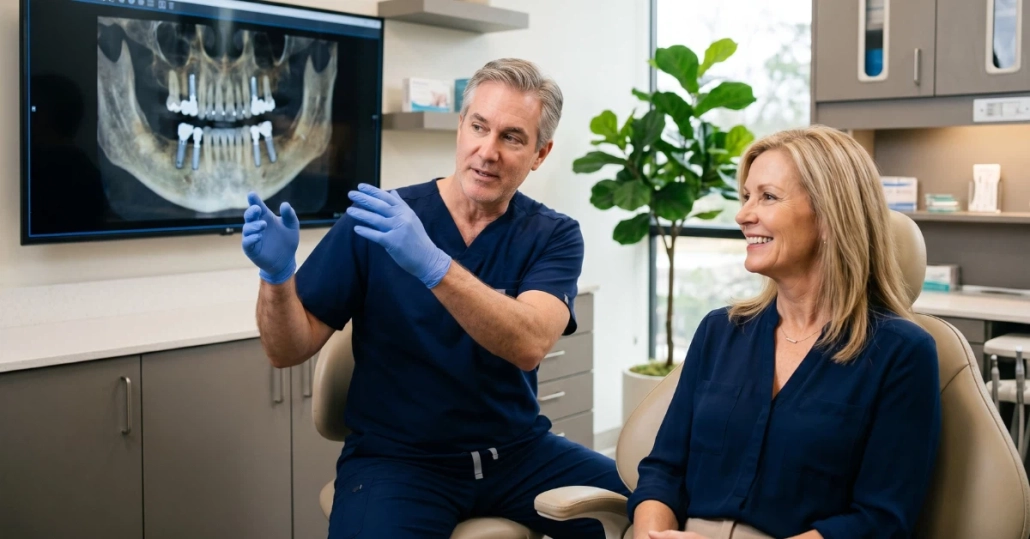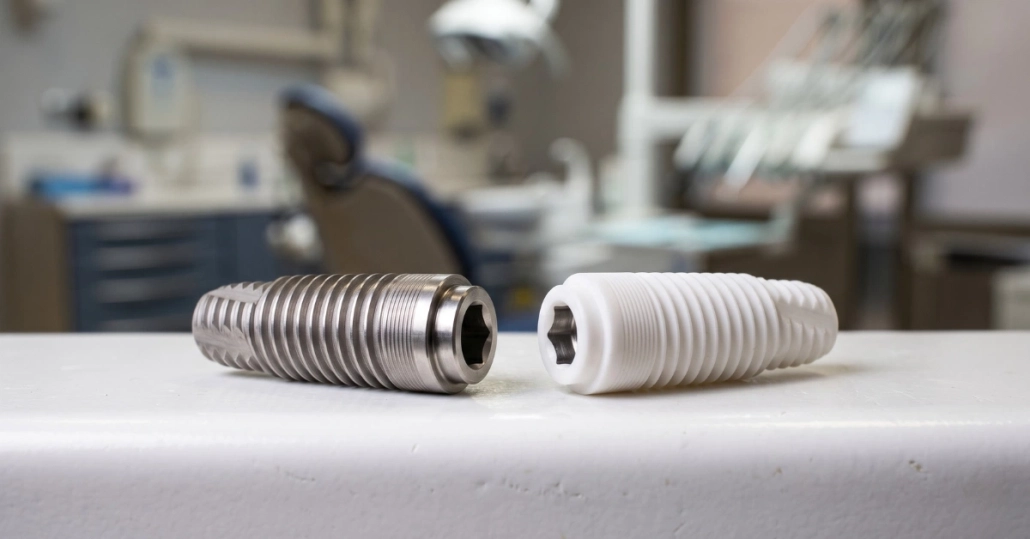
Snap-in dentures, also known as snap-on dentures, are removable dentures that clip onto dental implants in the jaw. They are one type of implant-supported dentures. Attachments anchor the denture to the implants and help it stay in place. If you wear regular dentures now, the questions to settle are how the two differ and whether the added cost makes sense for you.
700+ Google reviews for Optima Dental Surgery Center
Talk with our team about your case in a free 15-minute phone consultation, at a time you pick.
At Optima Dental Surgery Center in Round Rock, serving Northwest Austin, our team offers implant dentures that clip onto locators or a bar. For a lower denture, research reviews report two gains. People are more satisfied and chew better with implant support than with a regular denture. Whether that is worth the cost for you depends on how snap-in dentures work and the upkeep they need.
Besides snap-on dentures, snap-in dentures also go by clip-on, click-in, or pop-in dentures. In clinical writing they are called implant-retained dentures or overdentures. Each of these names means a denture you can take out that clips onto dental implants.
✔ Key Takeaways
- Implants help hold snap-in dentures steady, with two the standard for a lower denture and four or more for an upper.
- Ball and locator attachments sit on each implant, while a bar joins the implants. Locators are often chosen over a bar for lower upfront cost, and upkeep differs by design.
- CareCredit's 2026 national cost study puts snap-on, implant-retained dentures at $1,886 to $4,124, without saying whether that includes implant surgery or is per arch. Your own figure comes at the consultation.
- In pooled adult studies, 96.4% of modern implants in general survived 10 years. The American College of Prosthodontists advises having a denture checked for replacement once it is over 5 years old.
- Implants take about 3 to 6 months to fuse with the jawbone, sometimes longer after bone grafting. You wear a healing denture in the meantime.
- Snap-in dentures come out at night for cleaning, while All-on-4 stays fixed in place on four implants.
How Snap-On Dental Implants and Snap-In Dentures Actually Work
Traditional dentures rest on your gums and stay in place through suction, gravity, and sometimes adhesive. Implant-supported dentures, commonly called snap-in or snap-on dentures, work differently. They snap onto dental implants surgically placed in your jawbone. Because snap-in dentures anchor to implants rather than resting solely on gum tissue, they gain retention and stability.
The Basic Components
Think of snap-in dentures as three main parts working together, starting with the dental implants placed in your jawbone. The standard minimum is two implants for a lower denture and four or more for an upper one. The implants act as anchors, much like fence posts set in concrete. Over about three to six months, they fuse with your bone in a process called osseointegration.
Attachment components form the second part, and they connect the denture to these implants. Ball-and-socket attachments are one common design, and we’ll cover the other designs shortly. The “male” part attaches to the implant and sits above your gum line, and the “female” part embeds in your denture base.
The denture itself is the third part. It is a removable denture that looks like a traditional one but has housings for the attachment parts. You set it over the attachments and press down, and the parts snap together to lock it onto the implants. The snap connection gives the denture its retention and stability during daily use.
The Snap-In Mechanism Explained
Snap-in dentures use a mechanical attachment system that locks the denture onto dental implants. You can still take it out for cleaning. This snap design is what sets snap-in dentures apart from traditional dentures that rely on suction or adhesive alone.
The ball-and-socket system works just the way it sounds. Each implant receives a ball-shaped attachment that sits slightly above the gum tissue. Your denture has matching sockets in its base, each one a small metal housing with a rubber O-ring inside. The sockets line up with the implant positions.
When you insert the denture, the ball attachments fit into the sockets. The rubber O-rings grip the balls, creating the “snap” you feel and hear when the denture seats properly. This grip holds the denture against your gums. To remove it, you pull the denture free with enough pressure to overcome the O-ring grip.
Like a traditional denture, a snap-in denture is removable. You take it out at night to clean and soak it, then snap it back in the morning. A 2026 review of 21 randomized trials in older adults linked implant overdentures with better function and patient ratings than conventional dentures. Results varied widely between those trials.
How Many Implants Do You Actually Need?
This depends on which arch you’re treating and the specific system design. The 2002 McGill consensus statement named a two-implant overdenture the first choice for a lower jaw with no teeth. Two should be enough for most people, according to a 2012 review that calls it the minimum standard rather than the gold standard. A 2022 review still treats that design as the standard choice.
For an upper snap-in denture, published research supports four or more implants. Studies of upper implant dentures have used between two and eight implants. A 2019 review of 28 studies found higher implant survival with four or more, but denture survival and satisfaction did not depend on the count.
An upper snap-in denture can cover less of the roof of your mouth than a conventional one, if you want that and your anatomy allows. Some studies have successfully used palate-free designs on four to six implants spread widely along the arch. If you are missing all your upper or lower teeth, our team offers snap-on Locator dentures, bar-retained overdentures, and fixed implant bridges.
The number of implants may also matter for bone in the lower jaw. A 2021 review of 19 studies reported that four-implant lower overdentures can slow bone loss at the back of the jaw more than two-implant ones. It found no clear difference in that bone loss between two-implant overdentures and regular dentures.
Different Attachment Systems for Snap-In Dentures
Several attachment designs exist for snap-in dentures, and each affects stability, maintenance, and long-term cost. Choosing the right attachment system plays a major role in how snap-in dentures feel, function, and wear over time. Understanding the differences helps you make informed decisions about which system suits your needs.
Ball-and-Socket Attachments
This is a stud design, which means each implant carries its own attachment instead of sharing a bar with the others. Ball attachments screw onto the implants and project above the gum line. The denture contains metal housings with rubber O-rings that grip these balls when you insert the denture.
Ball-and-socket systems are relatively simple in design. Plastic retention parts wear faster than metal ones, a 2022 review found, yet ball and Locator-type systems ended up needing maintenance at similar rates. Neither design has a clear edge on upkeep.
The O-rings wear out over time, and as they wear, the denture can feel slightly looser. A 2022 lab study of O-rings removed after three years of use found that they deteriorate and need replacing to restore retention.
Ball attachments allow some rotational movement of the denture. The ball can turn slightly inside its socket, which lets the denture move a little as you chew. The next option, the Locator attachment, is built differently.
Locator Attachments
With a Locator system, the implant gets a flat abutment with a specific shape instead of a ball. The denture holds replaceable plastic inserts that grip this abutment and hold the denture in place when you seat it.
Locator attachments sit closer to the gum tissue than ball attachments. Their maker, Zest Dental Solutions, describes them as self-aligning, so the denture guides itself into position as you press down. The design can make the denture easier to put in if you have limited hand dexterity.
The plastic inserts are color-coded by retention strength. The standard inserts are blue for extra light retention, pink for light, and clear for regular. Your dentist can change the retention by switching the insert, for example if you prefer a tighter or looser fit.
Like O-rings, Locator inserts wear over time and need replacing. In a retrospective study at one U.S. dental school, 75 patients with Locator lower dentures averaged 7.7 maintenance visits over a mean of 5.2 years. Those visits covered maintenance of all kinds, and attachment replacement was the most frequent complication, at 63%.
Bar-Retained Attachments
Bar-retained systems connect multiple implants with a metal bar that runs along your gum line. The denture has clips or attachments that snap onto this bar. The bar joins, or splints, the implants together, while ball and Locator attachments stand alone on each implant.
A bar can join as few as two implants. A five-year randomized trial, for example, used bar-and-clip dentures on two lower implants. The bar is custom-made to fit your implant positions and jaw contours, which adds lab work and cost.
The bar needs extra cleaning under and around it each day. A 2016 review of upper dentures found more gum inflammation beneath bars, while stand-alone attachments needed more maintenance. It is a trade-off to weigh with our surgical team.
Locator attachments are often chosen over bars for their lower initial cost, researchers at one U.S. dental school note. For upper dentures, the research behind four or more implants covers both bars and stand-alone attachments.
Comparing System Options
- Ball-and-socket. This simple stud design allows some rotational movement. Its rubber O-rings wear over time and are replaced to restore retention.
- Locator. This lower-profile stud design is self-aligning, according to its maker. Its plastic inserts are color-coded by retention strength and are replaced as they wear.
- Bar-retained. A custom bar joins two or more implants. It costs more up front than Locator attachments and needs extra cleaning beneath the bar. Its clips are replaced as they wear.
- Stabili-Teeth™. This fixed full-arch system at Optima Dental Surgery Center uses 6 to 8 implants per arch and comes with same-day provisional teeth. It is not a snap-in attachment, so ask about it at your consultation if you would rather not take your teeth out.
Explore Each Attachment System Side by Side
Tap a system to see how it attaches, what wears, and who it may suit
Ball-and-Socket System
A stud design with a ball on each implant
A ball-shaped abutment on each implant snaps into a rubber O-ring housing in the denture base. The O-rings wear with use and are replaced to restore retention.
May suit
Patients who want a simple stud design and are comfortable with a little movement while chewing.
Locator System
Self-aligning design with adjustable retention strength
A flat, keyed abutment on the implant mates with a color-coded plastic insert in the denture. The maker describes the design as self-aligning, which can make seating easier if your hand dexterity is limited. Swapping insert colors changes the retention strength.
May suit
Patients with limited hand dexterity, those who prefer lower-profile hardware, or anyone who wants to fine-tune retention strength over time.
Bar-Retained System
A custom bar joins the implants into one unit
A custom-milled bar joins the implants along your gum line. The denture snaps onto clips on the bar. The bar needs extra daily cleaning beneath it, and research on upper dentures found more gum inflammation there. It costs more up front than Locator attachments.
May suit
Patients who prefer a splinted design and can keep up extra cleaning under the bar. A five-year trial tested bars on two implants in people with shrunken lower ridges.
Snap-In Dentures Pros and Cons
Snap-on dentures bring gains over a regular denture, and they come with trade-offs in cost, surgery, and upkeep. The lists below set out both, drawn from published sources, so you can weigh what implant-retained dentures offer against what they ask of you.
Pros of Snap-In Dentures (Implant-Supported Overdentures)
- A steadier denture. The snap-fit attachments anchor your denture to the implants, which adds retention and stability. A review of 53 studies, mostly of lower dentures, found that implant support clearly improved satisfaction.
- Improved chewing ability. In the same review, implant support raised chewing efficiency and maximum bite force. Both gains can help with firmer foods such as apples.
- May help preserve the jawbone. The jawbone gradually shrinks after tooth loss. Cleveland Clinic says implant-supported dentures help prevent that bone loss because the implants mimic natural tooth roots. Studies of two-implant lower overdentures show mixed results on bone.
- Natural appearance. Snap-in dentures are custom-made to match your facial features, gum color, and the tooth shape and shade you choose.
- Removable for easy cleaning. Unlike All-on-4 dental implants, snap-in overdentures come out at night for cleaning, which also lets you clean around the implant abutments.
- Fewer implants than permanent full-arch solutions. Snap-on dentures start at 2 implants per lower arch and 4 per upper arch. A fixed full-arch bridge usually takes 4 to 6, and Stabili-Teeth™ uses 6 to 8 per arch. A 2026 consensus report on upper jaws found overdentures cost less and involve less complex surgery than fixed full-arch bridges.
- Long-term durability. With brushing, flossing, and regular dental visits, implants can last many years. The denture on top is the part that gets replaced, and Cleveland Clinic puts the average denture lifespan at 7 to 10 years.
Cons of Snap-In Dentures
- Higher upfront cost than traditional dentures. Implant overdentures cost more than conventional dentures, since you pay for the implants and their placement as well as the denture. Your own figure comes at the consultation.
- Requires surgery. Your gums are numbed for implant placement, and sedation is an option. Most people return to routine activities in 2 to 3 days and feel normal within a week. Cleveland Clinic calls the risks usually minimal, and they include infection, nerve damage, injury to the mouth, and a hole in the sinus membrane.
- 3 to 6 months of healing. The implants fuse with your jawbone before the final snap-in attachments go on. Healing can take longer after bone grafting, and you wear a healing denture in the meantime.
- O-ring and attachment maintenance. O-rings and plastic inserts wear, and that loss of grip is the most common reason an overdenture needs maintenance. In one retrospective U.S. dental school study, five-year upkeep costs for Locator lower overdentures equaled or exceeded the initial cost.
- May require bone grafting. Implants need enough jawbone to hold them. If bone has been lost, bone grafting for implants may come first, adding time and cost. Our surgical team checks this with a CT scan taken during the consultation process at our Round Rock office.
- Still removable, not permanently fixed. If your goal is teeth that never come out, snap-in implant dentures are not the same as fully fixed All-on-4 implants. You will still remove them for cleaning.
- Daily cleaning routine required. Implant-supported dentures need consistent daily cleaning. Plaque left on the implants can inflame the surrounding gum.
For lower dentures, a 2009 British expert consensus found higher satisfaction and quality of life with implant overdentures than with regular dentures. A 2026 global consensus report cautions that this edge may not hold for the upper jaw. A consultation with Dr. Kris Owens or Dr. Faiza Ali helps you weigh these points for your own mouth.
The Treatment Process Step by Step
Understanding what actually happens from consultation to final denture helps you prepare mentally, logistically, and financially for implant-supported dentures. The timeline stretches over several months typically, with distinct phases.
Treatment Road Map
Phase 1, Consultation and Planning
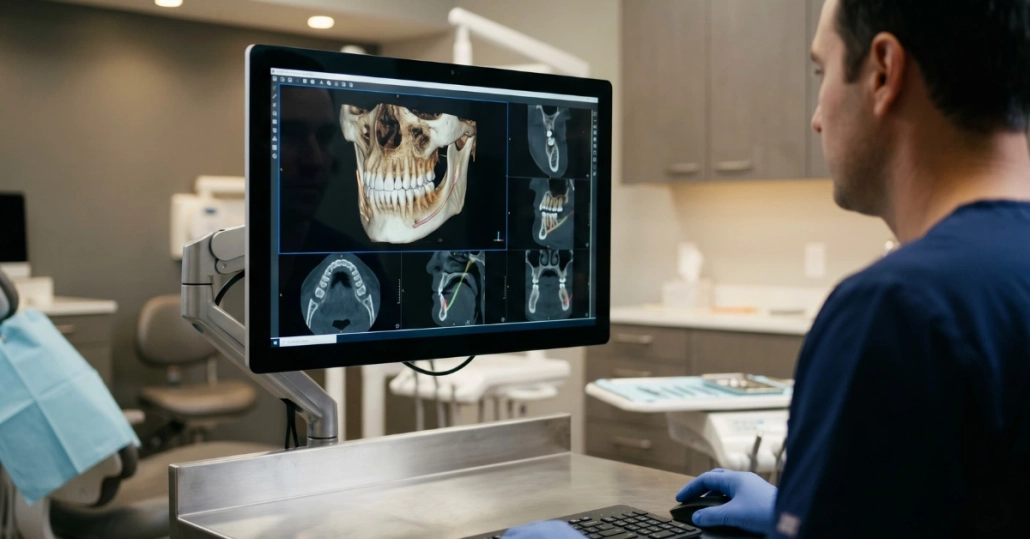
Planning starts with a free 15-minute phone consultation booked online, and a team member calls you at the time you pick. Your exam then takes place at our Round Rock office. Our surgical team includes a CT scan in the consultation process, so your plan starts from your actual jawbone. Implants need enough bone to hold them, and the scan shows how much you have.
If you wear dentures now, our surgeons check their condition. Sometimes your current denture can be modified to fit the new implants, and other times the team recommends a new one made alongside placement. The exam shows which path fits your case.
The consultation sets your treatment plan, starting with how many implants you need and which attachment system suits your case. It also shows whether you need a first step such as pre-implant tooth extractions or bone grafting. Your own timeline and cost come from this step as well.
Phase 2, Implant Placement Surgery
Before surgery begins, you receive anesthesia that numbs your gums, and sedation is an option if you prefer it. The surgeon makes small openings in the gum tissue and prepares a space in the bone for each implant. The implant posts are then placed into those spaces.
According to Cleveland Clinic, most people return to routine activities two to three days after implant surgery. Most feel normal within a week. For the healing months that follow, you wear a healing denture while the implants fuse with the bone.
Phase 3, Healing and Integration
The implants need about three to six months to fuse with your jawbone before they can hold the snap-in attachments and denture. Healing can take longer, especially if you had bone grafting. During this time, the posts bond with the surrounding bone in a process dentists call osseointegration, which anchors an implant in the jaw.
Your healing denture may be your current denture with changes, or a new one made for this phase. It works, but it does not attach to the implants. Because it sits free of them, the implants can heal properly before the snap-in attachments go on.
Phase 4, Attachment and Denture Delivery
Once the implants have fused with the bone, you return for the attachment visit, and the surgeon first exposes any implant covered by gum. The ball abutments, locator posts, or bar parts then go on, matched to your system. This visit usually takes about an hour and may need a second minor surgery.
If you’re using your existing dentures, the dentist modifies them to accept the attachment housings. This involves creating space in the denture base, placing the metal housings precisely aligned with the implant positions, and securing them permanently. If you’re getting new dentures, they’re fabricated with housings already positioned correctly.
At this visit, the team shows you how to snap the denture in and take it out. The motion may feel awkward at first, and practice at home helps. You go home with the denture snapped onto the implants, where the attachments now hold it in place.
Complete Timeline Expectations
- Consultation to surgery depends on your plan, since extractions or grafting may need a few months of healing before the implants go in.
- Surgery to healing completion takes about 3 to 6 months, and it can take longer after bone grafting.
- Attachment placement to final denture usually takes about an hour and may need a second minor surgery.
- Total timeline depends mainly on healing and on whether you need grafting. You get your own schedule at the consultation.
Some practices use immediate loading, where the denture snaps onto temporary attachments the day the implants go in. For lower implant overdentures, a 2025 review of 9 randomized trials found it a suitable option. Chewing and quality-of-life scores were also better than with conventional loading. Either way, the implants still need about three to six months to fuse with the jawbone, and bone grafting can add time.
Daily Maintenance and Care Requirements for Snap-In Dentures
Snap-in dentures require consistent maintenance to function properly, protect the implants underneath, and last their expected lifespan. The care routine differs somewhat from traditional dentures, with additional attention needed for the implant components.
Your Daily Care Routine
Morning routine starts with removing your implant-supported dentures. Grip the denture firmly and apply steady upward pressure to release the snap attachments. This takes more force than you might expect initially, because the attachments are designed to hold tight. Once you learn the proper technique, removal becomes quick and easy.
Rinse your mouth thoroughly with water or mouthwash. Gently brush your gums, tongue, and palate with a soft-bristle brush. This stimulates tissue circulation, removes bacteria, and keeps your mouth healthy. Pay attention to the tissue around the implant attachments, and use gentle circular motions to clean these areas without irritating the tissue.
Daily Care Routine Checklist
Track your morning and evening routine. Tap each step to mark it complete.
Clean the attachments themselves carefully. For ball attachments, wipe around the ball abutments with a soft cloth or cotton swab. For locator attachments, clean around the abutment posts. If you have a bar system, use interdental brushes or special cleaning tools to reach under and around the bar. Food particles and plaque accumulate here easily, so thorough daily cleaning prevents problems.
Clean your denture as you would a traditional denture, with extra attention to the attachment housings. Use a denture brush with a nonabrasive denture cleanser, or with mild soap and warm water, and skip anything abrasive. Work around and inside the metal housings where the O-rings or plastic inserts sit. Debris in these housings affects retention and can damage the attachment parts.
The evening routine mirrors the morning one, so remove the denture, clean your mouth and the attachments, and then clean the denture well. When you soak it in a denture cleanser, follow the cleanser maker’s directions on how long to leave it in. Zest, the LOCATOR maker, advises 15 minutes or less for LOCATOR overdentures. Never use hot or boiling water, which can warp a denture.
Before reinserting the denture, inspect the attachment components. Look for visible wear on O-rings or plastic inserts, check that housings are secure in the denture base, and confirm no cracks or damage exist. Insert the denture by aligning it carefully with the attachments and pressing firmly until you hear and feel the snap. The denture should seat completely against your tissue with no gaps or tilting.
What to Check While You Clean
Your daily cleaning is a good time to check the attachments. Watch for a snap that feels looser than before, a metal housing that moves when pressed, or redness around an implant. Each one is a reason to call our office. The section on common problems below covers what our team does about each.
Professional Maintenance Schedule
A common schedule is a checkup and cleaning every six months. A 2026 international consensus on upper implant dentures advises setting the interval by each patient’s risk profile, so yours may differ. Visits include a professional cleaning around the implants and a check of your gums, attachment parts, and denture. X-rays are taken from time to time to check the bone around the implants.
The hygienist cleans your implant-supported dentures more thoroughly than you can at home, removing any accumulated plaque or calculus from the denture and attachment housings. They also clean around the implant attachments professionally, reaching areas difficult to clean with home care alone.
Expect to replace the O-rings or plastic inserts now and then, since they wear with daily use. In a retrospective study of 75 patients at one U.S. dental school, replacing the attachment was the most frequent complication with LOCATOR lower overdentures. At each checkup, your dentist tests the snap and replaces worn parts. How often depends on how quickly your own parts wear.
The American College of Prosthodontists recommends a professional evaluation once a denture is more than 5 years old. Cleveland Clinic puts the average denture lifespan at 7 to 10 years. Your jawbone and gums keep changing slowly over time, even with implants, so the fit eventually calls for a new denture. The implants and attachments stay in place, and only the denture portion is replaced.
Snap-In Dentures Cost Up Front and Over Time
Snap-in dentures cost more than regular dentures and less than fixed full-arch teeth. Published estimates price the denture and each implant separately, so the number of implants you need shapes your total. Bone grafts or extractions can add to it. At the consultation, our team sets each option side by side so you can compare cost against how long it lasts.
Initial Treatment Investment
CareCredit’s 2026 national cost study puts snap-on implant-retained dentures at $1,886 to $4,124, with an average of $2,540. The study does not say whether that price includes implant surgery or covers one arch, so it may reflect the denture alone. Optima Dental Surgery Center publishes no snap-in price, so your exact figure comes at the consultation.
| Option | Published price | Implants | Removable? |
|---|---|---|---|
| Traditional full dentures | $1,493 to $3,309, average $2,022 | None | Yes |
| Snap-on implant-retained dentures | $1,886 to $4,124, average $2,540 | 2 lower, 4 or more upper | Yes |
| Full implant-supported dentures | $2,830 to $7,203 per implant, average $4,093 | Usually 4 to 6 | Depends on design |
| Stabili-Teeth™ at Optima Dental Surgery Center | $12,500 to $15,000 per arch | Usually 6 to 8 | No |
| All-on-4 at Optima Dental Surgery Center | Usually $20,000 to $28,000 per arch | 4 | No |
National prices come from CareCredit’s 2026 Synchrony Average Procedural Cost Study. The Implants column shows how many implants each option uses, not what its price covers. For snap-on dentures, the study does not say whether the price is for one arch or includes implant surgery. The figure may reflect the denture alone.
Full implant-supported dentures are priced per implant, so the study gives no total for two, four, or more implants. Stabili-Teeth™ and All-on-4 carry Optima Dental Surgery Center’s own published prices per arch. Your own total comes at the consultation.
Extra steps add to the total when your mouth needs them. In CareCredit’s 2026 study, a simple extraction averages $165 per tooth and a surgical one $375, and a dental exam with X-rays averages $210. Its 2024 study put a socket bone graft at $427 to $1,088, with an average of $558.
If you plan to finance, checking whether you qualify won’t affect your credit, and you can apply to more than one lender to compare offers. You can see the lenders we work with on our page about dental implant financing in Austin.
Ongoing Maintenance Costs
A 2022 review of lower overdenture studies found that the most common upkeep is restoring the snap as the O-ring, insert, or clip wears. Worn parts are reactivated or replaced. A retrospective University of Colorado study reviewed 75 patients with LOCATOR lower overdentures. Replacing the attachment was their most frequent complication, at 63%.
On average, those patients made 7.7 maintenance visits of all kinds over 5.2 years. Their five-year upkeep cost as much as the original treatment or more, and visits and costs ran higher for patients older than 75. The finding comes from one teaching clinic’s records.
Exams, relines, and the denture itself round out upkeep. A dental exam with X-rays averages $210 nationally in CareCredit’s 2026 study. The American College of Prosthodontists advises having a denture checked once it is more than five years old. Cleveland Clinic puts the average denture lifespan at seven to 10 years.
Snap-In Dentures vs. Traditional Dentures Cost Comparison
Traditional dentures cost less up front. CareCredit’s 2026 study puts them at $2,022 on average nationally and $1,995 in Texas, without saying whether that is per arch or per set. Cleveland Clinic advises relining them every one to two years, or when the fit changes. It puts their average lifespan at seven to 10 years.
Snap-in dentures cost more at the start and add attachment upkeep. A 2026 global consensus report on upper-jaw treatment lists higher cost and more maintenance than a regular denture. In the University of Colorado study, five years of upkeep cost as much as the first treatment or more.
The extra cost buys a denture held by implants, and the lower-jaw evidence for it is strong. In 2009, the British Society for the Study of Prosthetic Dentistry put lower implant overdentures significantly above regular dentures for satisfaction and quality of life. For the upper jaw, the 2026 global consensus report cautions that this evidence may not hold.
Compare your options and costs at a free consultation with Optima Dental Surgery Center.
Checking whether you qualify for dental implant financing won't affect your credit. You can apply to more than one lender and compare the offers you receive.
Does Insurance Cover Snap-In Dentures?
Insurance tends to treat the two parts of a snap-in denture differently. The denture, the part you take out to clean, counts as a major service that dental plans usually cover in part. Implant coverage varies more. Some carriers now cover implants as a major service, though they may limit how often.
The main types of coverage typically treat snap-in overdentures in these ways.
- PPO dental plans. Dentures usually fall under major services, which plans cover at their lowest rate, such as 50%. Each plan can still move a service to a lower tier. Deductibles usually run $50 to $100, and about 65% of dental PPOs have a yearly maximum of $1,500 or more. Some carriers now cover implants as a major service, sometimes limited to one per year.
- Original Medicare (Part A and B). In most cases, Medicare does not cover dental services or items such as dentures and implants. The exceptions are specific dental services tied directly to certain covered medical treatments.
- Medicare Advantage (Part C). In 2026, 98% of people in individual Medicare Advantage plans have a plan with a dental benefit, KFF reports. The benefit may cover only preventive care such as cleanings and X-rays, or it may extend to dentures. Many plans cap what they pay each year, and some require in-network dentists. When you call, ask about “implant-supported overdentures” by name.
- Medicaid (Texas). Texas Medicaid does not pay for general dental services for adults 21 and older, apart from narrow exceptions. Even the exception for dental needs caused by a life-threatening illness excludes dentures. Members of the STAR+PLUS Home and Community Based Services waiver can receive dentures, capped at $5,000 per service-plan year. Implants are not listed in that benefit.
- HSA and FSA accounts. IRS Publication 502 counts artificial teeth and dentures as medical expenses, and HSA funds can pay for that care. The publication does not name implants, and cosmetic work generally does not count. An FSA pays for what your employer’s plan specifies, so check your plan first.
What to Ask Your Insurance Provider
Vague questions tend to produce vague answers when you call your plan. Asking these specific questions gets you the information you need.
- “Does my plan cover implant-supported overdentures or implant-retained dentures?”
- “Is the implant placement surgery covered separately from the denture prosthetic?”
- “What is my annual maximum for major restorative services, and how much has been used this year?”
- “Does this procedure require pre-authorization?”
Bring the answers to your consultation. Once our team knows what your plan covers and leaves out, we can build your treatment plan around it. Payment options can then start from what your plan will actually pay.
Snap-In Dentures vs. All-on-4 Dental Implants
Snap-on dentures and the All-on-4 fixed implant system both use implants to hold a full arch of teeth. Choosing between them starts with whether you want teeth you take out to clean or teeth that stay fixed in place. The table below sets the two side by side.
← Scroll to compare →
| Factor | Snap-In DenturesImplant-retained overdenture |
All-on-4 ImplantsPermanently fixed arch |
|---|---|---|
| Implants needed | 2 or more per arch | 4 per arch |
| Removable? | Yes, taken out at night to clean | No, fixed in place on implants |
| Cost range | Less than fixed full-arch, quoted at your consultation | Usually $20,000 to $28,000 per arch |
| Healing time | 3 to 6 months, longer with grafting | 3 to 6 months to fuse, longer overall |
| Bone requirement | Enough bone, or a graft to add it | Enough bone, with more complex surgery |
| Maintenance | Removed to clean, worn O-rings or inserts replaced | Cleaned in place, with more hygiene work |
| Feel | Stable on implants, still removable | Fixed in place on four implants |
| Good fit for | Patients wanting stability plus removable convenience | Patients wanting permanently fixed teeth |
Snap-in implant dentures suit you if you want a denture held steady by implants that you still take out each night to clean. Compared with fixed full-arch teeth, a 2026 global consensus report on the upper jaw finds they cost less, need fewer implants, and involve simpler surgery. They are also easier to clean.
All-on-4 suits you if you want fixed teeth on four implants. The same report notes that fixed full-arch teeth cost more and bring more complex surgery, longer treatment, and more hygiene work. To compare fixed options further, read our comparison of All-on-4 vs. All-on-6 or our complete guide to full-arch dental implants.
At Optima Dental Surgery Center, Dr. Kris Owens performs full-arch All-on-X cases, and our surgical team also places snap-in overdentures. A CT scan at our Round Rock office is part of the consultation process, so your plan starts from your actual anatomy. Our team then sets the options side by side so you can compare cost against longevity.
Snap-In Dentures vs. Permanent (Fixed) Dentures
Patients sometimes use “permanent dentures” and “fixed dentures” interchangeably when they research their options. Both terms describe teeth attached to implants that stay in your mouth, which sets them apart from snap-in dentures. The difference shapes how you clean them and who can take them out.
Snap-in dentures, also called implant-retained dentures or overdentures, are removable. They attach to implants with a snap mechanism and you take them out each night for cleaning. They stay put when you eat, talk, and laugh. But they are not permanently fixed in the way natural teeth are.
Permanent or fixed dentures are screwed onto implants by your dentist and do not come out. All-on-4 and hybrid denture systems are two examples. You clean them in place, and only your dental provider can remove them.
Snap-in implant dentures sit in the middle ground between traditional removable dentures and fully fixed implant teeth. Implants hold them steady, yet they still come out. They fit when you want that steadier hold and like being able to take the denture out to clean it.
If you’re comparing snap-on dentures vs. permanent dentures, start with whether you want teeth that come out for cleaning or teeth that stay in. From there, your bone volume and your budget narrow the choice.
Should I Get Snap-In Dentures?
Answer 3 quick questions for a personalized starting point before your consultation
Question 1 of 3
Which option describes your current denture situation?
Question 2 of 3
Which change would mean the most to you?
Question 3 of 3
What matters most to you when choosing a solution?
⚠ This quiz is a starting point and not a clinical recommendation. At Optima Dental Surgery Center, only a CT scan and an in-person exam can confirm whether snap-in dentures suit your jawbone and budget.
Who Benefits Most From Snap-In Dentures?
Snap-in dentures work well for many patients, but certain situations particularly benefit from this solution. Understanding whether you fit these profiles helps determine if this investment makes sense for your specific case.
Ideal Candidates
Lower denture wearers who want a firmer hold are strong candidates. A lower denture has no palate to rest on, only the jawbone ridge. For the lower jaw, the 2002 McGill consensus named a two-implant overdenture the first choice of treatment. A 2012 review calls it the minimum standard of implant care, one that should be enough for most people.
Patients with enough bone who would rather not have full-arch implants can choose an overdenture as a middle ground. An overdenture costs less than a fixed full-arch implant denture, according to a 2026 international consensus report on the upper jaw. It also needs fewer implants and less complex surgery. You keep a denture you can take out, now anchored to implants.
If you use denture adhesive every day, a snap-in denture offers a different way to hold your teeth in place. The attachments anchor it to the implants, which gives it retention and stability without adhesive. A 2015 review of 53 studies, mostly short-term and of lower dentures, found that implant support improves chewing efficiency and clearly improves satisfaction.
Active people may value the added security. Whether you exercise, play sports, or simply keep busy, the snap attachments anchor your denture to the implants. The anchoring adds hold and stability while you move through your day.
Seniors and near-retirees around Round Rock and Northwest Austin can compare snap-on dentures with the two main alternatives on cost and function. They cost more than a conventional denture and less than a fixed full-arch implant denture. Implants anchor them for a steadier fit. If a wedding, reunion, or retirement party is on your calendar, ask about timing at your consultation, since healing takes months.
Situations Where Other Options Make More Sense
If your jaw needs more bone, grafting may come first. Some patients then heal for a few months before the implants go in, and implant healing can also run longer after a graft. CareCredit’s 2024 national cost study puts a socket bone graft at $427 to $1,088, and ridge expansion costs more. Your own figure comes at the consultation.
In these cases, a traditional denture or full-arch implants with grafting may suit you better than a snap-in denture. We offer ceramic dental implants as an option for patients with specific material preferences once bone volume is confirmed.
If you strongly prefer fixed teeth that never come out, full-arch implants provide that solution better than snap-in implant dentures. Yes, they cost significantly more, but they deliver the permanently fixed result some patients prioritize above all else. Our full-arch implant candidacy guide walks through exactly who qualifies and what to expect from that path.
If manual dexterity limits your ability to insert and remove dentures independently, snap-in overdentures might create challenges. The snap attachments require firm pressure and proper technique. If arthritis or other conditions affect your hand strength and coordination, discuss this concern with your dentist before proceeding.
A traditional denture is the lower-cost place to start if your budget is limited right now and you need teeth soon. You can still consider implant support later. Whether your current denture could be adapted to implants is something our surgeons check at the consultation.
Checking whether you qualify for financing won’t affect your credit, and you can apply to more than one lender and compare offers. Browse our overview of tooth replacement options to see costs and timelines side by side.
Cedar Park patients are seen at our Round Rock office, where our team can talk through whether snap-in dentures suit them. See our Cedar Park dental implants page for more.
Common Problems With Snap-In Dentures
Every removable prosthetic has a predictable set of maintenance challenges. Knowing what to watch for, and what it actually means when something changes, is part of making a confident decision about this treatment. None of the issues below are unusual, and none of them indicate that the implants have failed.
The Snap Feels Looser Over Time
The O-rings in ball-and-socket systems and the plastic inserts in locator systems wear down with daily use. The snap that felt firm at delivery slowly loosens. A 2022 review of lower overdentures on one or two implants found this wear the most common reason for maintenance. It is normal wear on parts designed to be replaced, and it does not mean anything has gone wrong with the implants.
Replacing the worn O-ring or insert at a routine visit restores the snap’s retention. How often you need it depends on your own wear, so the snap gets checked at each visit. Staying ahead of it, with parts replaced before they are worn through, helps you avoid a denture that rocks when you chew.
Tissue Irritation Around the Implant Attachments
Redness, tenderness, or swelling around an implant post can signal peri-implant mucositis, an early inflammation of the gum around the implant. A 2017 World Workshop consensus report found strong evidence that plaque causes it. The attachment hardware needs deliberate cleaning because of its shape. Debris collects in the gap between the abutment and the gum when brushing stays at the surface.
When you see these signs, clean more carefully at home and book a professional cleaning around the implants. Plaque is also linked to peri-implantitis. The same 2017 report defines it by inflamed gums around the implant and progressive loss of the bone that supports it.
The Attachment Housing Works Loose in the Denture Base
Occasionally the metal housing that holds the O-ring or insert loosens from the denture base. You will notice it rocks slightly when you press on it. The denture may also stop seating flush against your gums, even when you feel the snap engage.
A loose housing is a job for the dentist, who removes it, prepares the denture base, and bonds the housing back in place. Attempting to reattach it with over-the-counter adhesive typically makes the professional repair more difficult without correcting the fit.
Insertion and Removal Are Harder Than Expected
Some patients, particularly those managing arthritis or limited hand strength, find the snap takes more deliberate force than they expected. Zest, which makes LOCATOR attachments, describes them as pivoting and self-aligning, a design it credits with less damage from improper seating. With ball-and-socket systems, practice helps you find the right angle and pressure.
If removal still takes too much effort after some practice, ask your dentist about the retention strength of your inserts. LOCATOR inserts are color-coded by retention level. In Zest’s standard range for the original LOCATOR, blue is extra light, pink is light, and clear is regular. A lighter insert takes less force to remove, and your dentist weighs that against how firmly the denture holds.
The Upper Denture Rocks Slightly Even When Snapped In
An upper snap-in denture can sometimes rock slightly, even when it is fully seated. The number of implants is one factor worth reviewing. For the upper jaw, a 2026 global consensus report says the research supports four or more implants. They can be joined by a bar or stand alone with stud attachments.
A 2019 review of 28 studies found higher implant survival with four or more upper implants. Denture survival and patient satisfaction were not significantly affected by the number, though. A bar can also join as few as two implants, as a 5-year trial in the lower jaw showed. Our surgical team reviews the fit and these options with you at a follow-up visit.
Making Your Decision About Implant-Supported Dentures
Whether snap-in dentures are worth it for you comes down to one trade-off. You pay more than for a conventional denture and gain a denture anchored to implants. Your jawbone and your budget weigh most in that choice, and the points below also cover upkeep and treatment time.
The denture you wear now is the first test. If it stays put, feels comfortable, and lets you eat what you like, an upgrade may add less than it costs. For upper dentures, 2026 consensus guidelines say a satisfied patient with healthy tissues needs only routine maintenance. When a denture slips or rules out certain foods, implant support deserves a closer look.
Bone sets the limits. Implants need enough jawbone to hold them, and the CT scan in your consultation process shows what you have. Where bone has been lost, a graft can add volume in many cases, and some patients then heal for a few months before placement. Cleveland Clinic says implant-supported dentures help prevent bone loss, though research on two-implant lower overdentures is mixed.
Budget is the other deciding factor. CareCredit’s 2026 national cost study puts full traditional dentures at $1,493 to $3,309 and snap-on implant-retained dentures at $1,886 to $4,124. The study does not say whether these prices are per arch, or whether the snap-on figure includes implant surgery. Your own figure comes at the consultation.
Upkeep belongs in the budget too. In a retrospective study at one U.S. dental school, five-year upkeep for LOCATOR lower overdentures equaled or exceeded the initial treatment cost. The daily routine takes time as well, with the denture and attachments cleaned every morning and evening. Worn inserts and O-rings get replaced at checkups, so plan for regular visits.
Treatment also takes months. Healing after implant placement runs about three to six months and can take longer after bone grafting. You wear a healing denture while the implants heal. If you need a stable denture sooner, raise it at your consultation, where you get your own schedule.
Taken together, these points lead to one of three paths.
- Choose implant-supported dentures if you have enough bone, the cost fits your budget, and you want a denture anchored to implants for a firmer hold.
- Stick with traditional dentures if current dentures work reasonably well, bone volume is insufficient without grafting, budget is limited, or you prefer the simplest solution.
- Consider full-arch implants if you want fixed teeth that you do not take out and you can afford the higher cost.
Before you decide, get a thorough consultation with a dentist experienced in implant-supported dentures. It should include imaging of your bone, the attachment system that suits your case, your cost including upkeep, and a realistic timeline. To hear from patients who have already made this choice, read what our Round Rock patients say.
Snap-in dentures suit patients who choose them for the right reasons. Their cost sits between a conventional denture and fixed full-arch implants, and they still come out for cleaning. The implants anchor them for added hold. For lower dentures, a 2009 British consensus statement found satisfaction and quality of life significantly greater with implant support than with a conventional denture.
If you are ready to see whether implant-supported dentures fit your situation, Optima Dental Surgery Center starts with a free 15-minute phone consultation. A team member calls at a time you choose. At the office visit in Round Rock, a CT scan, part of the consultation process, shows your bone. Our surgical team then sets your options side by side so you can compare cost against longevity.
Ready to See Which Snap-In Denture Fits You?
Ask our team at Optima Dental Surgery Center in Round Rock about snap-in dentures. We can talk through how locator and bar options fit your jaw and budget.
Schedule Your Free ConsultationFrequently Asked Questions About Snap-In Dentures
What are snap-in dentures and how do they work?
Snap-in dentures are removable dentures that attach securely to dental implants placed in the jaw. Instead of relying on suction or adhesive, the denture snaps onto implant attachments that hold it steady. You can still take it out for daily cleaning. They're also called implant-supported dentures, implant-retained dentures, or overdentures, all names for the same type of solution.
How are snap-in dentures different from traditional dentures?
Traditional dentures rest on the gums and rely on the palate or the lower jaw ridge for support. Snap-in dentures are anchored to implants, whose attachments keep the denture stable. A 2015 review of 53 studies, mostly short-term and of lower dentures, found implant support improves chewing, increases bite force, and clearly raises satisfaction. You can still take a snap-in denture out to clean it.
How many implants are needed for snap-in dentures?
Two implants are the standard minimum for a lower snap-in denture, and a 2012 review calls that minimum enough for most people. For an upper denture, a 2026 global consensus report says the literature supports four or more.
In a 2019 upper-jaw review, implant survival was higher with four or more, while overdenture survival and satisfaction did not depend significantly on the count. Your own number is planned from the CT scan that is part of your consultation.
Are snap-in dentures removable?
Yes. Snap-in dentures are designed to be removed daily for cleaning and maintenance. They stay firmly in place during normal activities but can be detached by applying steady upward pressure. This removable design makes hygiene easier compared to fixed full-arch implant options.
How much do snap-in dentures cost?
Optima Dental Surgery Center quotes your own snap-in price at the consultation. CareCredit's 2026 national cost study puts snap-on implant-retained dentures at $1,886 to $4,124, without saying whether that covers implant surgery or one arch.
Snap-on dentures are cheaper than fixed full-arch implants and cost more than regular dentures. At our office, Stabili-Teeth™ runs $12,500 to $15,000 per arch, and All-on-4 usually $20,000 to $28,000 per arch. Checking whether you qualify for financing won't affect your credit, and you can compare offers from more than one lender.
How long do snap-in dentures last and what maintenance is required?
With care, the implants can last many years. A 2019 review of 18 studies in the Journal of Dentistry estimated 10-year survival at 96.4% per implant. The figure covers adult implants in general, whatever they support.
For the denture itself, the American College of Prosthodontists advises an evaluation once it is more than five years old. Cleveland Clinic puts the average denture lifespan at seven to 10 years. The most common upkeep is replacing O-rings, inserts, or clips as they wear.
Are snap-on dentures the same as snap-in dentures?
Yes. Snap-on and snap-in dentures are the same thing, removable dentures that attach to dental implants with a snap fit. People also call them clip-on, click-in, or pop-in dentures, as well as implant-supported dentures, implant-retained dentures, or overdentures. The attachment may be a ball, a locator, or a bar.
Can you sleep with snap-in dentures?
Plan to take them out at night. Like traditional dentures, snap-in dentures are removable, and Cleveland Clinic describes taking them out nightly to clean and soak them. Removing the denture also lets you clean around the implant abutments. While it is out, keeping it in water helps it hold its shape, and the cleanser maker's instructions set the soak time.
Do snap-in dentures look natural?
Snap-in dentures are custom made to look natural, matched to your facial features, gum coloring, and desired tooth shape and shade. In one small study of 21 people with upper overdentures on two implants, patients rated the look higher when the denture left the palate open. Whether your upper denture can do the same depends on your anatomy and on what you want.
What is the failure rate of snap-in dentures?
In a 2019 Journal of Dentistry review of 18 studies, 10-year survival for adult implants in general was 96.4% per implant. When patients lost to follow-up were counted, the estimate fell to 93.2%. People 65 and older came in at 91.5% in that analysis.
Your denture has its own lifespan to plan for. The American College of Prosthodontists advises an evaluation once a denture is more than five years old. Cleveland Clinic gives an average denture lifespan of seven to 10 years.
What are the most common problems with snap-in dentures?
The most common is a looser snap as O-rings or plastic inserts wear. A 2022 review of lower overdenture studies names this wear the most frequent maintenance need. Replacing or reactivating the worn part restores the hold. The denture base can also need a reline or a fracture repair, both part of routine overdenture care.
Gum inflammation around the implants is the third, and dental plaque is what causes it. Plaque is also tied to peri-implantitis, where the bone around an implant is gradually lost, so daily cleaning around the attachments matters.
Does dental insurance cover snap-in dentures?
Dental plans usually cover dentures as a major service at their lowest rate, such as 50%, and some carriers now cover implants too. In most cases, Original Medicare does not cover dentures or implants, and Medicare Advantage dental benefits vary by plan.
HSA funds can pay for dentures, which the IRS counts as a medical expense, though its list does not name implants. An FSA pays what your employer's plan specifies. For the balance, checking whether you qualify for dental implant financing won't affect your credit, and you can compare offers from more than one lender.
Do snap-in dentures cover the roof of your mouth?
An upper snap-in denture can leave part or all of the roof of your mouth open, if you want that and your anatomy allows it. A regular full denture rests on the gums and relies on the palate, the roof of the mouth, for support.
Palate-free upper designs on four to six implants spread along the arch have worked in some studies. In one small 2025 study of 14 patients with four upper implants, leaving the palate open improved chewing and swallowing of solid food.
Are snap-in dentures worth it?
For a lower denture, research strongly favors them over regular dentures. A 2026 review of 21 randomized trials in older adults linked implant overdentures with better patient-reported and functional results, though the trials varied widely.
For an upper denture, a 2026 global consensus report cites gains in satisfaction and quality of life. It also cautions that the stronger lower-jaw evidence may not carry over. If you are happy with your upper denture's fit, look, and function and your gums are healthy, the report advises only routine maintenance.