You’ve been told you need to replace a missing tooth or two, or maybe several. Your dentist handed you two options, a removable partial denture or dental implants. Now you’re weighing dental implants vs. partial dentures, trying to figure out which direction makes sense for your life, your budget, and your mouth.
A removable partial denture usually costs less, and you take it out to clean it. Your dentist will probably recommend leaving it out overnight. A dental implant costs more, and some patients wait up to several months for it to heal before the replacement tooth goes on. In return, it stays anchored in your jaw without involving the neighboring teeth. A third option, the implant-retained partial denture, is a removable partial that gets part of its support from implants.
I’m Dr. Kris Owens, a periodontist board certified in periodontology and dental implant surgery. At Optima Dental Surgery Center, I place both single implants and bone grafts. To see which option fits your own mouth, book a free consultation with our team in Round Rock.
What Each Option Actually Is
A removable partial denture is a set of replacement teeth on a pink or gum-colored plastic base. According to the American Dental Association’s guide to partials, it may have a metal framework with clasps that connect to your natural teeth, or other connectors that look more natural. In some cases, the partial attaches to your natural teeth with small devices that are generally more esthetic than clasps.
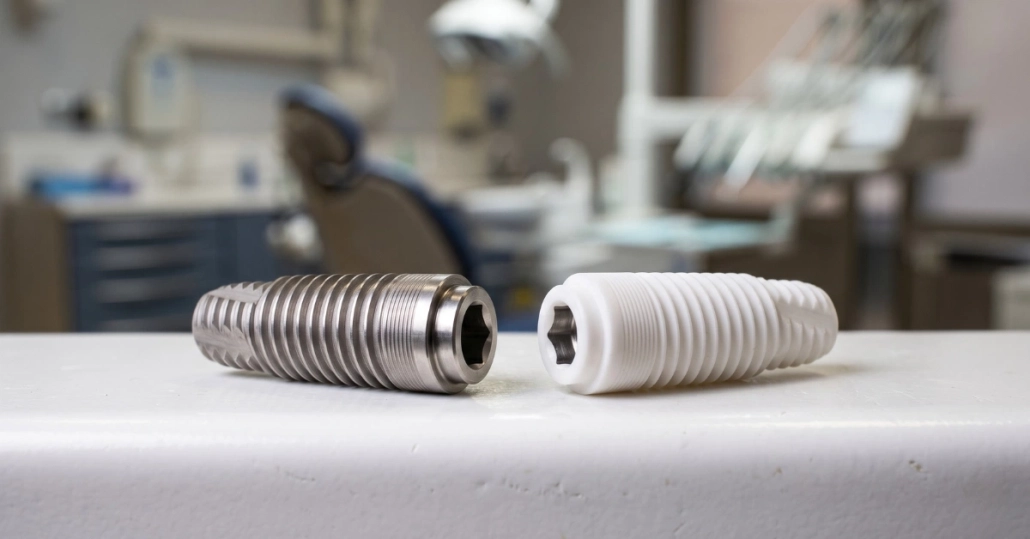
A dental implant needs none of those connectors. It is a titanium post placed into your jawbone, and in a process called osseointegration the bone heals around the post and holds it in place. Once the implant has healed, your dentist attaches the abutment, a small connector post, and then the crown. If you’re missing only one tooth, our single-tooth denture vs implant guide compares the options for that case.
What a Partial Denture and an Implant Cost
CareCredit and Cherry, two of the financing companies we work with, publish national cost figures. CareCredit’s partial denture averages come from the 2026 Synchrony Average Procedural Cost Study of dental practices across the United States. Cherry gives a typical range for a single implant with its crown.
- Metal partial denture, national average $2,293, with a range of $1,700 to $3,717
- Resin-based partial denture, national average $1,784, with a range of $1,335 to $2,873
- Flexible nylon partial denture, national average $1,780, with a range of $1,296 to $2,916
- Single implant with its crown, typically $3,000 to $6,000, including the implant post, abutment and crown
Even the low end of Cherry’s implant range sits above the national average for every type of partial in the CareCredit study. The implant figure covers a single tooth, though, while a partial carries all of its replacement teeth on one base. CareCredit notes that actual cost can vary widely from one provider and location to another, so your own quote comes from your consultation.
Upfront price is only part of the comparison, because a partial denture also changes with you. As your bone and gum ridges shrink, the fit loosens. The American College of Prosthodontists notes that these tissue changes call for relining, rebasing or remaking. Its position statement adds that there is currently no evidence to set how often that should happen. It recommends evaluating a partial for replacement once it has been in function for more than 5 years.
Relining and remaking apply to full dentures that rest on the gums as well, and implants usually last longer than alternatives like those traditional dentures, according to Cleveland Clinic. With good care, implants can often last a lifetime.
For Austin patients who want to spread an implant’s cost over time, Optima Dental Surgery Center offers dental implant financing through partners including CareCredit and Cherry.
| Treatment | Cost | How it stays in | Cleaning | Upkeep over time | Time to finish | Bone |
|---|---|---|---|---|---|---|
| Removable partial denture | $1,780 to $2,293 averages by material | Clasps or connectors on natural teeth | Brushed daily, usually out overnight | Relined or remade as tissues change | Several visits, around two months | Ridge keeps resorbing under it |
| Dental implant | Typically $3,000 to $6,000 for one tooth | Titanium post the jawbone grows around | Brushing, flossing, dental visits | Can often last a lifetime with care | Three to nine months of healing | May help preserve jawbone |
Partial denture costs are 2026 national averages published by CareCredit. The implant range is Cherry’s, crown included. Your own quote comes from your consultation. The two-month figure is CareCredit’s for dentures in general. Some patients get the implant and teeth in one visit, and a needed bone graft adds its own healing time.
Your own figures depend on how many teeth you’re replacing and on your bone, and we go over both at your free consultation.
Schedule Your Free Consultation
Comfort and Daily Life With a Partial or an Implant
A new partial denture may feel awkward or bulky at first, and the American Dental Association says you will eventually become accustomed to wearing it. Its advice is to start with soft foods cut into small pieces, chew on both sides of your mouth, and avoid foods that are extremely sticky or hard. Reading out loud helps with words that are hard to pronounce.
After that adjustment, the anchor teeth the clasps hold onto matter over the longer run. In a 2024 study of clasp-retained metal partials, losing anchor teeth accounted for the vast majority of the partials that failed. Some clasp designs were also significantly linked to decay and removal of those teeth. When a supporting tooth is lost, the American College of Prosthodontists’ position statement calls for evaluating the partial for replacement.
An implant needs no anchor tooth, but it asks for patience up front. Its healing phase can take three to nine months, depending on how quickly your body heals, Cleveland Clinic explains.
When the jaw lacks enough bone to support an implant, your provider may place a bone graft for implants first. The graft itself needs at least three months to heal, and a large one may take nine to 12 months.
Our guide to what happens after implant placement walks through the recovery, the healing phase and the attachment of your permanent restoration. Once the crown is attached, caring for your implant comes down to brushing, flossing and regular dental visits.
What Happens to the Jawbone After Tooth Loss
When a tooth is lost, the part of the jawbone that supported it can deteriorate or be resorbed. Natural teeth stimulate the bone and help maintain its volume, the American Association of Oral and Maxillofacial Surgeons explains, and losing them can cause the bone to shrink over time.
The shrinking is fastest early on. A 2012 review of 20 studies found the steepest reductions in the first 3 to 6 months after an extraction, with more gradual change after that. In its human studies of extraction sites left to heal unassisted, the ridge lost 29% to 63% of its width and 11% to 22% of its height within those 6 months.
A partial denture rests on that changing ridge. Resorption continues throughout life while the denture base keeps its shape, the American College of Prosthodontists notes, so the misfit grows over time. An ill-fitting denture can in turn contribute to mouth sores and, with prolonged use, bone loss, according to the American Dental Association.
Dental implants, by contrast, are placed into the bone, and Cleveland Clinic lists jawbone preservation among their benefits, so an implant may help maintain bone in that area. This isn’t certain, and outcomes vary by patient.
Factors That Point Toward a Partial or an Implant
Candidacy is individual, and your general health matters more than your age, according to the American Dental Association’s implant guide. A retiree in good general health, for example, may still have implants as an option. Chronic illnesses such as diabetes may interfere with healing after surgery, and tobacco can slow it. Our general candidacy framework goes deeper on who qualifies for implants, and our guide to replacing missing teeth sets out the wider range of options.
When a Partial Denture May Fit Better
- Upfront cost is the primary constraint and the patient understands the ongoing relining and remaking a partial needs
- Overall health factors make surgical procedures inadvisable
- Bone loss is already substantial and a bone graft would add months to the implant timeline
- Teeth are needed sooner than an implant’s healing time allows
When an Implant May Fit Better
- One to several teeth need replacement in areas where enough jawbone is present
- Leaving neighboring teeth untouched is a priority, since an implant replaces a tooth without involving them
- The patient prefers fixed teeth to a removable partial
- A replacement that can often last a lifetime with good care matters more than the lowest upfront cost
- The patient is in good general health, which matters more than age
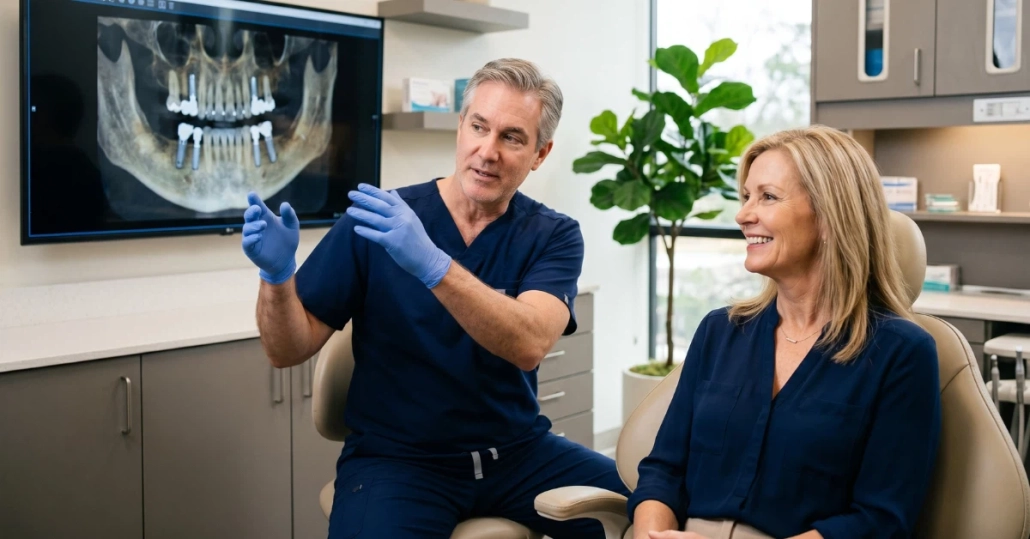
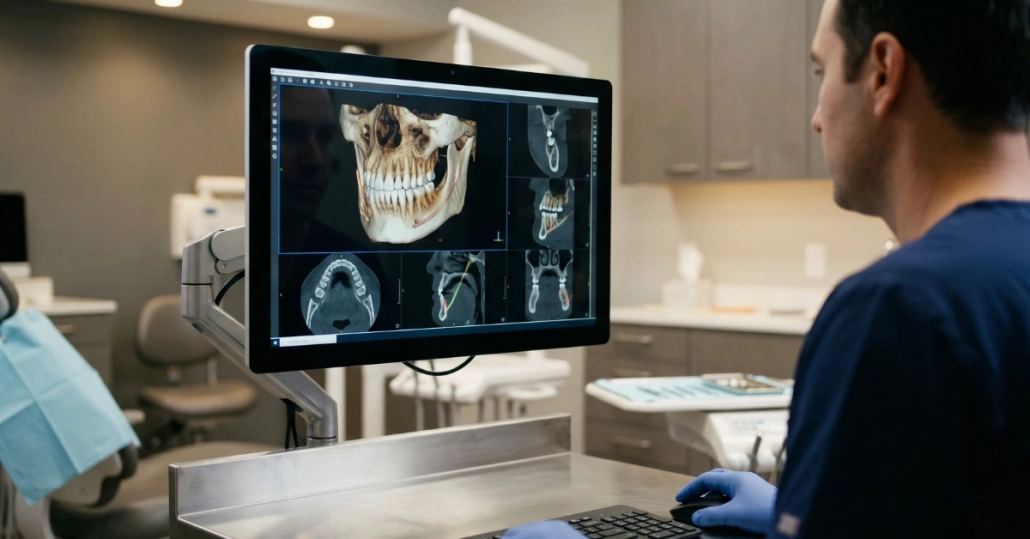
At Optima, we use 3D cone beam CT imaging as part of our consultation process to assess bone density and volume before making any recommendations.
Implant Support for Partials, Bridges and Full Arches
Partial Implants and the Implant-Retained Partial Denture
An implant-retained partial denture is a removable partial that gets part of its support from dental implants beneath it. People missing several teeth in scattered areas can benefit from implant-supported partial dentures, according to Cleveland Clinic’s page on implant-supported dentures. Implant-supported dentures come in removable and nonremovable options, the page adds.
The clearest case is a gap at the end of the arch, with no natural tooth behind the missing back teeth. There, the back end of a regular partial rests on gum tissue, and the soft gum and the anchor teeth do not give in the same way. A 2021 review of implants under partial dentures links that layout to movement of the partial, loss of retention, gum irritation and discomfort from the clasps.
An implant placed under the back end adds support and retention, the same review explains, which reduces the twisting force on the anchor tooth and the need for clasps. Its authors also report better retention, stability, comfort and satisfaction, along with less need for relining.
Across the 19 studies in that review, implant survival under these partials was 91% or higher, though the studies varied widely and few followed patients beyond 5 years. So the evidence speaks mainly to end-of-arch gaps and says little yet about the long run.
Patients who decline a fully fixed treatment because of cost, surgery or appearance can also benefit, a 2026 review notes. The same review names people who want to avoid visible clasps or a plate covering the palate. The attachments that hold this kind of partial may need regular maintenance as their parts wear. Research comparing designs and implant positions is still limited, according to a 2024 scoping review.
A bridge on implants, unlike this partial, stays in place. Cleveland Clinic describes it as two or more implants supporting a permanent bridge that replaces three or more teeth. Our guide on choosing between a dental implant and a bridge covers a different pairing, a single implant against a bridge held by natural teeth.
Replacing every tooth in an upper or lower arch opens other options. The removable version on implants is a snap-in denture, which our snap-in dentures guide explains. Our Stabili-Teeth™ full-arch system and the All-on-X procedure are our full-arch implant options.
How to Think Through This Decision
In my view, the decision belongs to you, and it gets clearer once you answer a few questions for yourself.
- What budget range can I realistically work with? Include financing options, along with the relining and remaking a partial needs over the years
- How important is a fixed versus removable solution to my daily life? Some patients are genuinely fine with a removable partial. Others find the concept difficult to accept long-term, and an implant-retained partial stays removable while implants carry part of its support
- What is my timeline? If someone needs teeth for a wedding or retirement event in two months, an implant that needs several months of healing may not fit that window. Some patients can have the implant and teeth placed in one visit
- What does my bone situation look like? This one can only be answered with imaging, so a consultation before committing to any path makes sense
Optima Dental Surgery Center is in Round Rock, and we see patients from across Austin, Waco, Temple and Killeen. No single option is right for everyone, so when you’re ready to talk through your own answers, schedule a free consultation with our team or call (512) 341-2321.