You’ve been told you need to replace a missing tooth or two – or maybe several. Your dentist handed you two options: a removable partial denture or dental implants. Now you’re sitting with that information, trying to figure out which direction makes sense for your life, your budget, and your mouth.
I’ve walked thousands of patients through this exact comparison here at Optima Dental Surgery Center. What I consistently find is that people come in with a surface-level understanding of both options, and that’s not their fault. Most of the information online is either too technical or too vague to help someone make a real decision. So let me give you what you actually need – a grounded comparison of dental implants vs. partial dentures that includes a real cost context for the Austin market and an honest look at what living with each option is like.
What Each Option Actually Is
Before comparing them, it helps to understand what you’re comparing. A partial denture is a removable appliance, typically made with acrylic or metal framework, that clips onto remaining natural teeth using metal clasps. You take it out to clean it, and it can move or shift while you chew or speak.
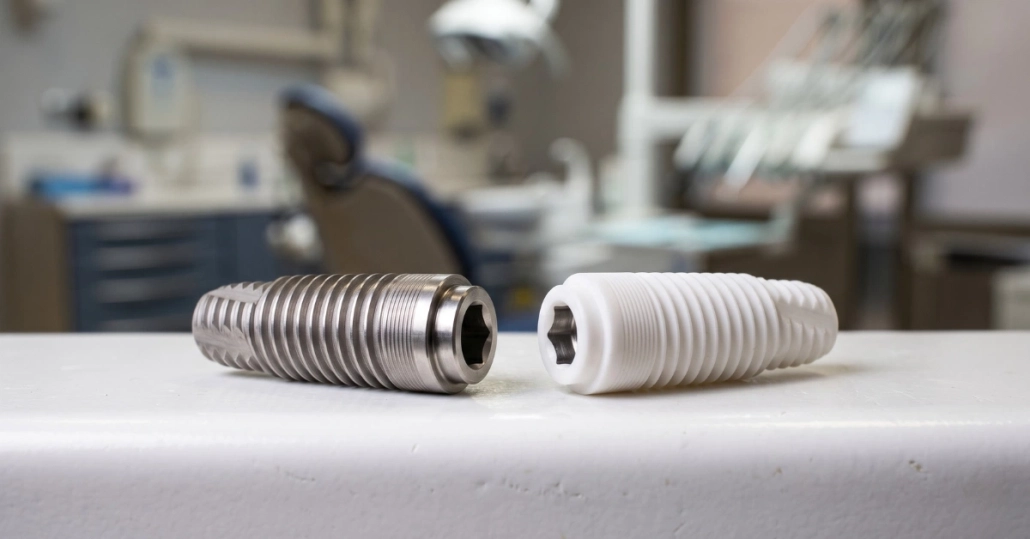
A dental implant is a titanium post placed into your jawbone that fuses with the bone over several months. Once that fusion – called osseointegration – occurs, a crown is attached to the top. The result is a tooth replacement that stays in place, functions like a natural tooth, and requires no removal for cleaning.
That difference in design is what drives almost every other comparison between them.
The Cost Comparison in Austin
Cost is the first question most patients ask, and I want to address it directly rather than give you vague ranges that leave you no better off than before.
In the Austin market, patients generally see the following cost ranges:
- Partial dentures – typically range from $1,200 to $2,500, depending on the number of teeth being replaced, the material used, and whether any extractions are needed beforehand
- Single dental implant with crown – generally falls between $3,500 and $5,500 per tooth in Austin, which includes the implant post, abutment, and crown
- Multiple implants – when replacing several teeth, costs are calculated per implant, though implant-supported bridges can reduce the per-tooth cost by using fewer implants to support more crowns
Those numbers look dramatically different at first glance. But that comparison requires one more layer to be useful: the 10-year picture.
Partial dentures typically require relining or replacement every five to seven years as your jawbone changes shape. Some patients need two or three sets over a decade. When you add relines, adjustments, and eventual replacements, the long-term cost of a partial denture can approach or exceed the cost of an implant – without providing the same experience or outcomes.
Implants, when the bone accepts them, and proper care is maintained, can last significantly longer than partial dentures. That longer timeline matters when you’re thinking about total investment rather than upfront cost.
For Austin patients exploring financing, Optima Dental Surgery Center works with multiple partners offering dental implant financing to help spread costs over time, which changes the monthly payment considerably.
The Patient Experience: What No One Tells You Before You Decide
I want to be direct here because I think patients deserve honesty over sales language.
Partial dentures take adjustment. Most patients need weeks to get comfortable speaking clearly with one in place. Eating certain foods – particularly anything hard, chewy, or sticky – requires ongoing caution. The metal clasps that hold the denture in place put pressure on the natural teeth they hook onto, which can sometimes accelerate wear on those anchor teeth over time. And the movement, however slight, is something patients notice. Some adjust completely. Others find it difficult to ignore.
Implants require a different kind of patience. The process takes time – typically three to six months from placement to final crown in straightforward cases, sometimes longer when bone grafting is needed first. There’s a surgical phase, a healing phase, and a restoration phase. That timeline is worth understanding before you begin.
What patients consistently report after completing the implant process is that they stop thinking about their teeth. They eat what they want, speak without worry, and handle caring for your implant the same way they would natural teeth – brushing, flossing, and regular cleanings. That return to normalcy is what most mid-life and older adults are actually seeking.
Bone Loss: The Factor That Changes Everything Long-Term
There’s a biological reality about missing teeth that affects this comparison significantly, and I find many patients haven’t been told about it clearly.
When a tooth root is no longer present in the jaw, the bone in that area begins to resorb. The body reads the absence of stimulation as a signal that bone isn’t needed there, and it begins to withdraw it. This process starts within the first year after tooth loss and continues over time.
Partial dentures sit on top of the gum and do not address this bone loss. Over years, the changing bone shape is what causes a denture to fit less securely – requiring those periodic relines.
Dental implants, because the titanium post is placed into the bone, provide stimulation that may help maintain bone volume in that area. This isn’t a guarantee, and outcomes vary by patient, but it’s a structural advantage that affects both long-term oral health and the stability of surrounding teeth.
For patients in their 50s and 60s, this distinction carries real weight. The bone loss that goes unaddressed in your 50s becomes a more significant factor by your 70s – when options may become more limited and bone grafting for implants may be required before any placement can happen.
Who Is a Candidate for Each Option?
This is where an in-person evaluation matters, because candidacy is individual. That said, here’s a general candidacy framework that helps patients understand where they likely fall before that consultation.
Partial dentures are often appropriate when:
- Multiple teeth are missing across different areas of the mouth, making implants for each tooth impractical from a cost or complexity standpoint
- Upfront cost is the primary constraint and the patient understands the ongoing maintenance requirements
- Overall health factors make surgical procedures inadvisable
- Bone loss is already substantial and bone grafting would significantly extend the timeline and cost of implants
Dental implants are often appropriate when:
- One to several teeth need replacement in areas where adequate bone is present
- Preserving surrounding teeth is a priority – implants don’t rely on neighboring teeth for support the way bridges and partial clasps do
- The patient wants a fixed solution that doesn’t require removal
- Long-term value matters more than lowest upfront cost
- The patient is in reasonable general health and can undergo a minor surgical procedure
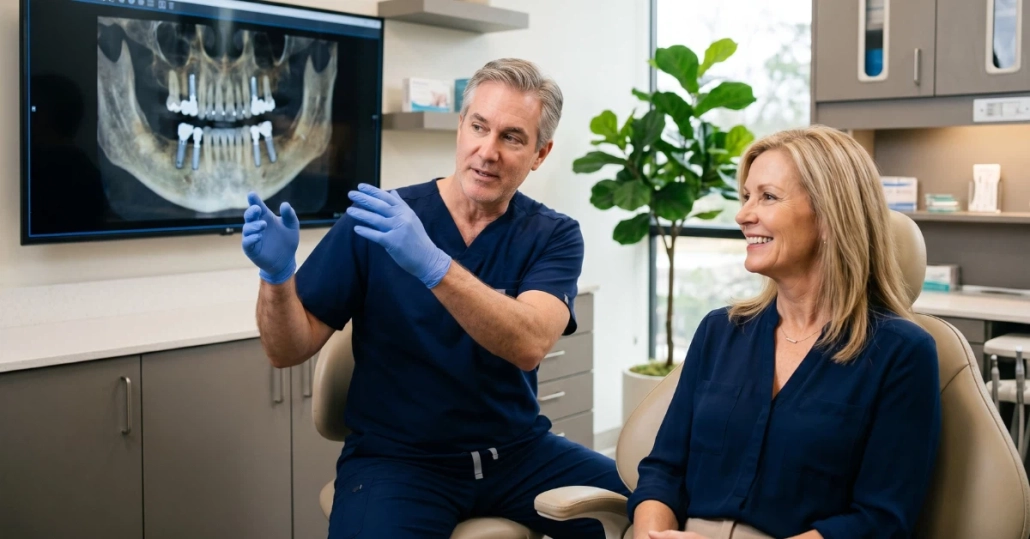
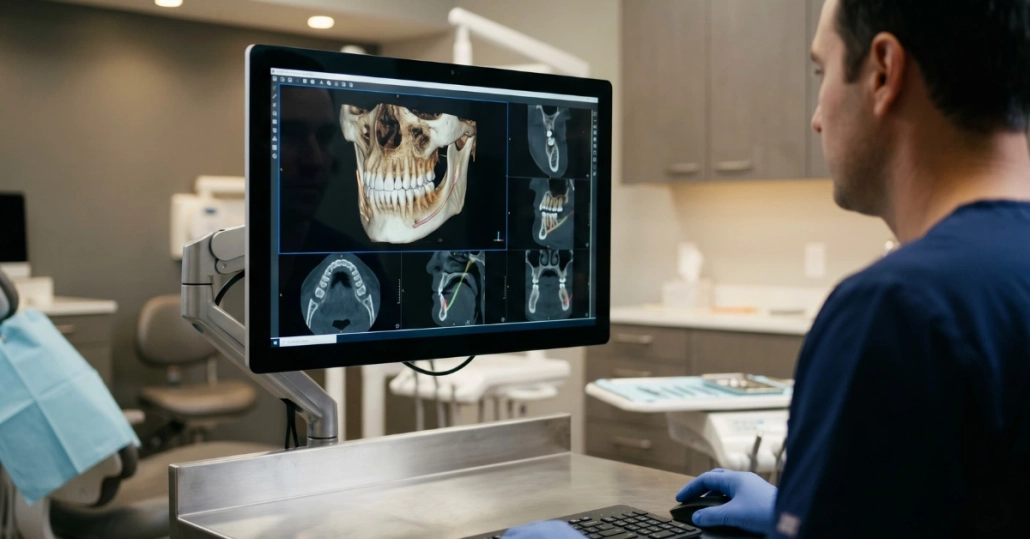
At Optima, we use 3D cone beam CT imaging as part of our consultation process to assess bone density and volume before making any recommendations. What’s available in your jaw – not just what’s visible on the surface – drives the recommendation.
What About Implant-Supported Partial Solutions?
There’s a middle category worth knowing about, particularly for patients who need to replace several teeth but are weighing cost against function.
Our implant-supported bridge guide covers how two or more implants can anchor a fixed bridge that replaces multiple teeth. This gives patients a fixed, non-removable solution at a lower per-tooth cost than placing individual implants for each missing tooth.
For patients who are replacing three to five teeth in the same arch section, this approach may offer a meaningful middle ground – the stability and bone preservation benefits of implants, with a cost structure that’s more accessible than fully individual replacements.
For patients considering full-arch replacement – where all upper or lower teeth need to go – our Stabili-teeth® full-arch system or the All-on-X procedure is worth exploring. It uses a smaller number of strategically placed implants to support a full arch of fixed teeth, and it’s specifically designed for patients who have been living with failing teeth or dentures and want a permanent, fixed solution.
How to Think Through This Decision
After walking through this comparison hundreds of times, I’ve found the decision usually comes down to four questions patients need to answer for themselves:
- What is my honest budget range? Not the minimum I can spend, but the range I can realistically work with – including financing options
- How important is a fixed versus removable solution to my daily life? Some patients are genuinely fine with a removable partial. Others find the concept difficult to accept long-term
- What is my timeline? If someone needs teeth for a wedding or retirement event in two months, implants may not fit that window. Partial dentures can often be placed more quickly
- What does my bone situation look like? This one can only be answered with imaging, which is why a consultation before committing to either path makes sense
Neither option is right for everyone. What matters is that you’re making the choice based on accurate information – including what each path will actually look and feel like five years from now, not just at placement.
Frequently Asked Questions
Is a dental implant worth the extra cost compared to a partial denture?
For many patients, yes – particularly when you consider the full timeline. Implants may offer longer service life, don’t require the removal and reline cycles of partials, and address the underlying bone loss that missing teeth cause. Whether the upfront difference is worth it depends on your specific health situation, tooth count, and financial circumstances. A consultation with imaging gives you the clearest picture.
How long does it take to get a dental implant in Austin?
The typical timeline from implant placement to final crown is three to six months for straightforward cases. If bone grafting is needed first, the process can take nine to twelve months or longer. Partial dentures can generally be placed within a few weeks of extractions.
Can I get implants if I’ve been wearing a partial denture for years?
Possibly, though the bone situation needs evaluation first. Years of wearing a partial without implants may mean meaningful bone loss has occurred in the missing tooth area. A 3D CT scan can show how much bone remains and whether grafting would be needed – our guide on implant candidacy evaluation walks through what that assessment typically involves.
Do dental implants hurt?
The surgical procedure is performed under local anesthesia, and most patients report the discomfort during recovery is manageable with over-the-counter pain relief. Individual experiences vary, and your surgeon will walk you through what to expect specific to your case before the procedure.
What is the Stabili-teeth® system?
Stabili-teeth® is Optima’s full-arch implant solution for patients who need to replace all teeth on an arch. It uses strategically placed implants to support a fixed set of teeth – meaning no removal for cleaning and no adhesives. It’s designed for patients who are done with dentures and want a permanent solution. Our full-arch implant guide covers the procedure, candidacy, and what recovery looks like in detail.
At Optima Dental Surgery Center, we serve patients across Austin, Round Rock, Waco and Temple. Our consultations include 3D cone beam imaging so we can show you what’s actually happening in your jaw before making any recommendations. We also work with multiple financing partners so cost doesn’t automatically close the door on the option that makes the most sense for you.
If you’re ready to stop weighing the options in the abstract and get a real picture of what’s possible, schedule a consultation with our team. Bring your questions. We’ll give you straight answers.