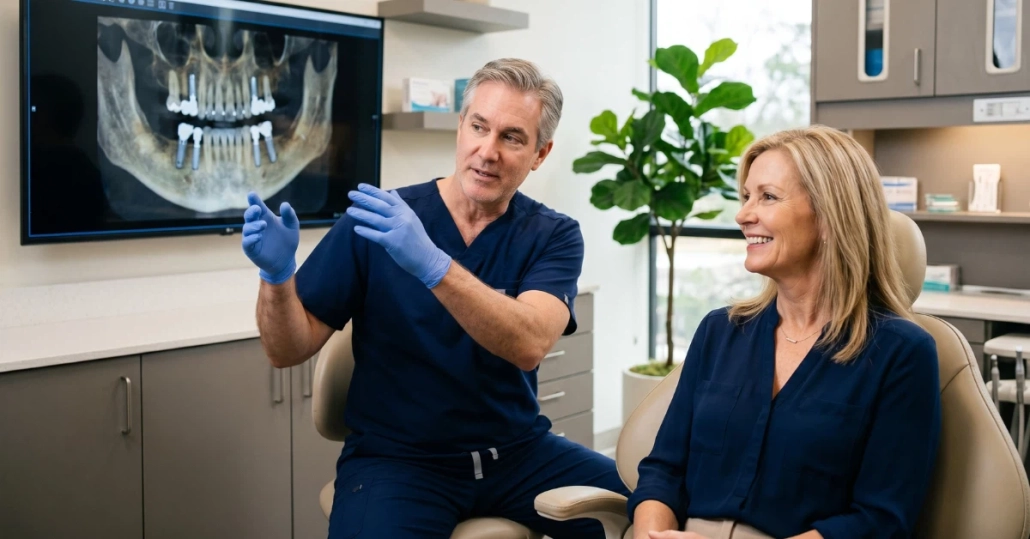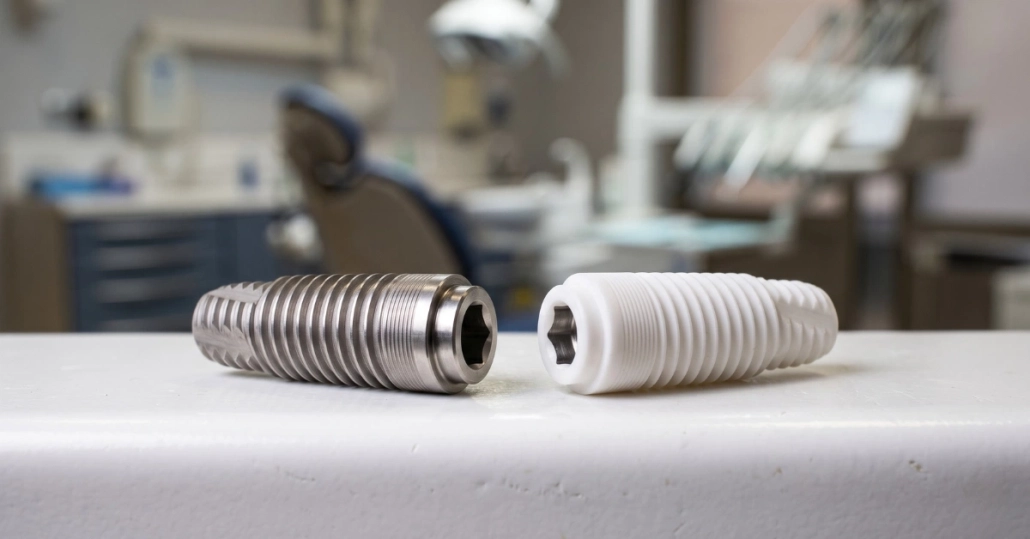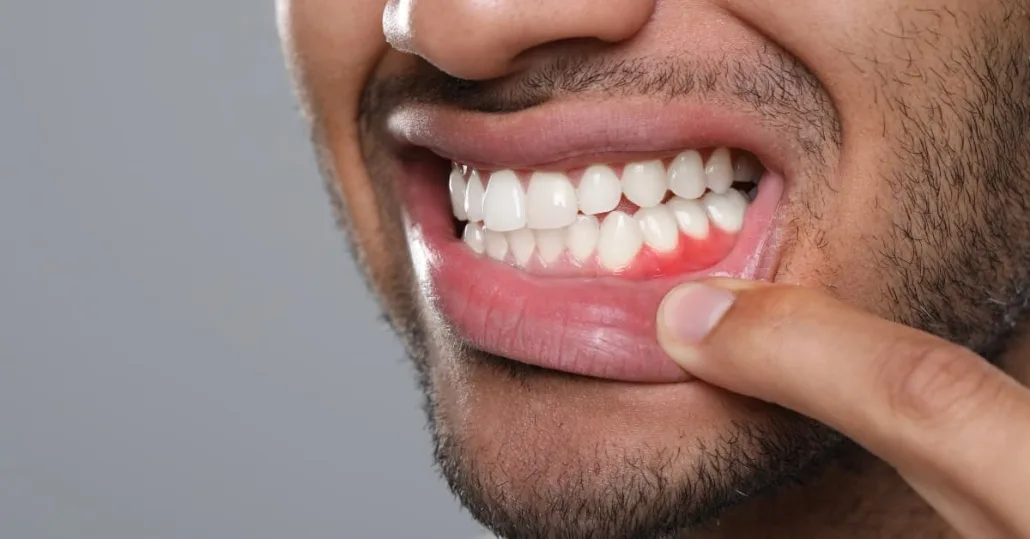
Snap-in dentures are removable dentures that snap onto dental implants in your jawbone and stay securely in place until you’re ready to take them out, as Cleveland Clinic describes them. You may also hear them called snap-on dentures, clip-on dentures, implant-retained dentures or overdentures. They’re all the same thing.
We’ll keep it plain and honest. You’ll see what they cost, their pros and cons, who they suit and how they compare with fixed teeth, then the treatment steps and the care they need.
Wondering whether snap-in dentures could work for your own mouth? Ask our team at Optima Dental Surgery Center on a free 15-minute phone call. A team member calls you at the time you pick, and you can ask anything.
Schedule Your Free Consultation
Snap-In Dentures at a Glance
Here are the short answers first, in case you’re reading between errands. The price comes from CareCredit’s 2026 national cost study.
How Snap-In Dentures Work With Implants and Attachments
A snap-in denture stays put by gripping small attachments on implants in your jaw. The implants sit in the bone, and the denture clicks onto them a bit like a press stud on a denim jacket.
They come as stand-alone studs or a bar that joins the implants, as the 2026 Global Consensus report on the upper jaw describes.
How many implants you need depends on the jaw. For snap-in lower dentures, the 2002 McGill consensus statement said a two-implant overdenture should become the first choice of treatment. A 2011 review in the Journal of Dentistry adds that two implants are not the gold standard but the minimum standard, which should be enough for most people. The upper jaw asks for more, and the Global Consensus report says the research supports four or more implants there.
Snap-In Dentures Cost and What Changes the Price
Snap-in dentures average $2,540 in CareCredit’s 2026 study, with a range of $1,886 to $4,124. The study doesn’t say whether its price includes implant surgery or covers one arch, so it may reflect the denture alone. For comparison, CareCredit puts full traditional removable dentures at an average of $2,022, ranging from $1,493 to $3,309, and $1,995 on average in Texas.
Your own total depends on what your mouth needs, starting with how many implants. CareCredit’s study prices full implant-supported dentures at an average of $4,093 per implant, with a range of $2,830 to $7,203. In CareCredit’s study, a simple extraction averages $165 and a surgical extraction $375, and bone grafting and the denture itself add to the total too.
We don’t publish a snap-in denture price, but our full-arch implant prices show the other end of the scale. Our cost page lists All-on-4 usually at $20,000 to $28,000 per arch, All-on-6 at $23,000 to $32,000 and Stabili-Teeth™ at $12,500 to $15,000, depending on bone, materials, sedation and grafting.
Upkeep belongs in the budget as well. A University of Colorado study in the Journal of Prosthetic Dentistry in 2022 reviewed 75 patients with LOCATOR lower overdentures at its dental school and found five years of upkeep cost as much as the original treatment or more. Patients averaged 7.7 maintenance visits over a mean of 5.2 years, with more visits and costs for those older than 75. These are one teaching clinic’s records.
Insurance, Financing and Ways to Pay
Insurance may help, depending on your plan. CareCredit reports that private dental policies typically cover 50% of the cost of partial or full dentures, though some plans cover traditional dentures but limit coverage for implant-supported ones. Medicare.gov says Original Medicare doesn’t cover dentures or implants in most cases, while CareCredit notes a Medicare Advantage plan may cover dentures fully or partially.
Taxes are worth a look too. IRS Publication 502 lets you include what you pay for artificial teeth in your medical expenses, though the publication doesn’t name implants.
For the rest, our dental implant financing options come through CareCredit, Cherry, Proceed Finance, LendingClub and PatientFi. Checking whether you qualify is a soft credit check that won’t affect your credit, and you can apply to several lenders and compare offers side by side. Your own figure comes at the consultation.
Talk Over Your Payment Options With Us
On a free 15-minute call, we can walk you through CareCredit, Cherry and our other lenders.
Snap-In Dentures Pros and Cons
Price is only one side of the decision. Here’s how snap-in dentures weigh up, with each benefit beside its trade-off.
The 2015 review of 53 studies in the Journal of Oral Rehabilitation mostly had one year of follow-up. The York statement came from the British Society for the Study of Prosthetic Dentistry, and the 2019 review of 18 studies in the Journal of Dentistry covered implants whatever they support.
What Snap-In Dentures Look Like
Looks count too, and Cleveland Clinic says implant-supported dentures look like natural teeth. Your new denture is also custom made for your mouth rather than taken off a shelf.

Who Snap-In Dentures Suit
Snap-in dentures tend to suit someone whose denture slips and who wants more hold without the cost and surgery of fixed teeth. Here are signs a snap-in denture may suit you.
Signs a snap-in denture may suit you
- Your lower denture slips and you’d like implants to hold it in place.
- You want a denture you can take out to clean.
- Your budget sits between a regular denture and fixed implant teeth.
- You have enough jawbone for implants, or room for a bone graft.
Signs another option may suit you better
The Global Consensus report says an upper denture you’re satisfied with in hold, look and function, with healthy tissues, needs nothing more than routine maintenance.
- You want fixed teeth that don’t come out at home.
- Your upper denture already fits well and your gums are healthy.
- You’d need bone grafting before implants, which adds healing time.
If fixed teeth sound closer to what you want, our full-arch candidacy guide explains who tends to qualify. Our missing-teeth options page also lists a LOCATOR denture, All-on-4 and individual implants.
Snap-In Dentures vs Fixed Implant Teeth and All-on-4
The core difference is that a snap-in denture comes out at home and fixed implant teeth, which many people search for as permanent dentures, don’t. Cleveland Clinic notes that a fixed denture, sometimes called a hybrid denture, is removed only by your dentist for maintenance when needed. The Global Consensus report adds that an overdenture costs less, needs fewer implants, involves less complex surgery and is easier to clean. Fixed full-arch teeth, it says, bring higher cost, more complex surgery, longer treatment and harder daily cleaning.
| Feature | Snap-in denture | All-on-4 | Stabili-Teeth™ |
|---|---|---|---|
| Implants per arch | 2 lower, 4+ upper (consensus reports) | 4 (our cost page) | 6 to 8 (our Stabili-Teeth™ page) |
| Removable at home | Yes, it snaps out | No, fixed teeth | No, fixed teeth |
| Published price | $2,540 avg (CareCredit 2026) | $20,000 to $28,000/arch (our cost page) | $12,500 to $15,000/arch (our cost page) |
| Cleaning | Take out, clean denture and implants | In place, harder to clean | In place, harder to clean |
| Often suits | A budget below fixed teeth | Teeth that stay in at home | Fixed teeth at a lower published price |
Choosing comes down to what matters most to you. If you want teeth that stay in and you’re ready for more involved surgery, All-on-4 or Stabili-Teeth™ may be worth exploring. Our All-on-4 vs All-on-6 guide compares the two on cost and who suits each by bone density. If you’d rather keep surgery simpler and don’t mind taking your teeth out to clean, a snap-in denture deserves a close look.
How Snap-In Denture Treatment Works in Four Steps
Once you’ve chosen a snap-in denture, Cleveland Clinic outlines four steps over several months.
- Get your mouth ready. Any extractions and bone grafting come first. You may then heal for a few months before the implants go in.
- Place the implants. A surgeon places the implants. Cleveland Clinic says the risks are usually minimal, and possible complications include infection, nerve damage, injury to the mouth and a hole in the sinus membrane. In most cases, people return to routine activities in two to three days and feel normal within a week.
- Let the implants fuse. The implants take about three to six months to fuse with your jawbone, and it can take longer, especially after bone grafting. Meanwhile you wear a healing denture, which works but doesn’t attach to the implants.
- Snap on your new denture. Your dentist attaches your custom denture to the implants and shows you how to clean and care for it. That’s when it finally snaps into place.
After the implants go in, call us at (512) 341-2321 if you notice severe bleeding, pain that doesn’t improve with medication, pus or infection near the implants, or a fever of 101°F or higher, the warning signs Cleveland Clinic lists.
Daily Care, Checkups and Replacing O-Rings
Once the denture is in, care comes down to daily cleaning and regular visits. Taking it out lets you reach the implant abutments to clean them, as the American Dental Association’s dentures page notes.
The honest answer to what goes wrong with snap-in dentures is that the snap loosens as parts wear. A 2022 study in the Journal of Oral Implantology found the O-rings in ball-retained overdentures wear with time and need replacing to restore the hold. In the Colorado study, replacing the attachment was the most frequent complication, at 63%. The worn O-ring, insert or clip is then replaced to restore the snap.
Cleveland Clinic’s dentures guide advises a reline every one to two years, or whenever the fit changes, and puts the average lifespan of a denture at seven to 10 years. On its implant-supported dentures page, Cleveland Clinic says the overdenture on top of the implants is replaced every 15 to 20 years for optimal results. The American College of Prosthodontists recommends having a denture evaluated for replacement once it’s more than five years old, as the American Dental Association reports.
A snap-in denture sits between a regular denture and fixed teeth, holds on through implants and comes out when you want it to, with steady upkeep along the way. Whether it suits you depends on your bone, your budget and what you want from your teeth. Our consultation guide explains what to expect at a dental implant consultation.
Every mouth is different, and so is every budget. The simplest way to find out where snap-in dentures fit in your plans is to talk it over with our team.
Call us at (512) 341-2321 or schedule your free consultation below, and a team member will call you for a 15-minute chat at the time you pick.
Schedule Your Free Consultation